
Acoustic Masking Physics | Calibrated Background Noise for Concentration
Learn the wave mechanics of spectral attenuation. Discover how implementing background noise for concentration, brown noise for studying, and 40 hz binaural beats shields cognitive endurance.
Dreamy Music Paradise CopyWriting Team
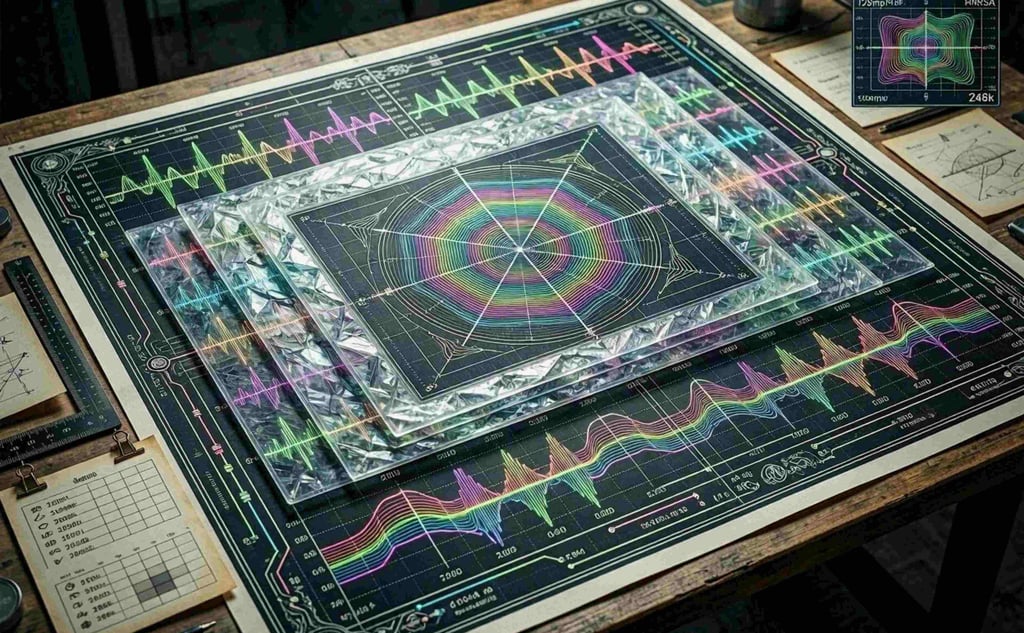
The Physics of Auditory Masking: Engineering the Ultimate High-Performance Sound Barriers for Cognitive Endurance
Explore the technical signal mechanics of spectral attenuation, phase alignment, and power-law acoustic design to eliminate distractions and unlock relentless workflow productivity.
The modern information workspace is an active battleground where human attention is constantly fragmented by environmental noise. From the unpredictable echoes of an open-plan office to the transient disruptions of an urban household, irregular sounds continuously challenge our internal focus networks. Most standard attempts to mitigate these distractions rely on simple music choices or passive silences, both of which fail to protect long-form analytical thinking. True cognitive endurance requires a shift in perspective: we must view the acoustic environment not as a passive background, but as a manageable physical space governed by the strict laws of wave mechanics and digital signal processing. By implementing highly calibrated acoustic masking fields—such as mathematically structured brown noise for studying or precise 40 hz binaural beats for deep concentration—we can build an impenetrable auditory shield that protects the brain's processing capacity from sudden external shocks.
Fun Fact 1: The designation of "brown noise" is not derived from a color spectrum, but from the botanical pioneer Robert Brown. In 1827, Brown documented the continuous, chaotic movement of microscopic pollen particles suspended in fluid, a phenomenon now known as Brownian motion. When mapped into audio signal generation, this exact mathematical random walk creates a power spectrum that falls at a rate of 6 decibels per octave (1/f² spectral density), delivering the deep, steady rumble that forms the ultimate foundation for environmental sound masking.
The Engineering Mechanics of Spectral Attenuation and Signal Design
To construct an effective acoustic barrier, we must first understand why standard environmental sounds break focus so easily. The human auditory system did not evolve to maintain continuous concentration on high-level data analysis in a silent room. It evolved as an active survival radar, highly attuned to sudden shifts in the surrounding environment. When an office door slams or a coworker speaks, the brainstem registers a sudden change in amplitude and frequency, instantly forcing the prefrontal cortex to shift attention toward the disruption.
This tracking reflex is governed by the signal-to-noise ratio (SNR). In a completely quiet environment, the background sound level is extremely low. Consequently, any sudden sound creates a massive spike in the SNR, capturing the brain's attention networks and causing an abrupt lapse in focus. To prevent this, audio engineering introduces a continuous, steady acoustic noise floor. By raising the background level with a mathematically uniform sound mask, sudden external noises are absorbed into the existing sound field. The signal-to-noise ratio remains perfectly flat, allowing the analytical mind to maintain a stable, uninterrupted workflow.
Acoustic Signal Profiles compared: [Silent Room Baseline] ───► [Sudden Office Noise (High SNR Spike)] ───► Focus Shattered [Calibrated Sound Mask] ───► [Sudden Office Noise (Absorbed into Floor)] ──► Uninterrupted Flow
The specific frequency distribution of this sound mask determines its performance. While traditional white noise contains equal energy across all audible frequencies, its high-frequency energy can sound harsh and cause sensory fatigue over multi-hour listening blocks. True performance engineering favors a brown noise loop, which downscales higher frequencies to emphasize a deep, powerful low-end foundation. This specific structure aligns perfectly with the human ear's natural acoustic sensitivity, masking distracting high-frequency office chatter while remaining comfortable during long periods of intense screen work.
┌──────────────────────────┬─────────────────────────────┬─────────────────────────┐│ Audio Spectrum Category │ Mathematical Energy Curve │ Operational Performance │ ├──────────────────────────┼─────────────────────────────┼─────────────────────────┤│ White Noise Configuration│ Constant Energy (1/f⁰) │ Harsh Highs, Fast Fatigue│ │ Pink Noise Architecture │ 3dB Drop per Octave (1/f) │ Balanced Reading Shield │ │ Brownian Noise Shield │ 6dB Drop per Octave (1/f²)│ Deep Rumble, Maximum Mask│ └──────────────────────────┴─────────────────────────────┴─────────────────────────┘
When building these files for extreme focus, standard audio exports introduce subtle technical flaws. Standard compression algorithms create micro-stuttering along the timeline, which a resting brain can register as a subtle alert signal. To eliminate this issue, high-performance sound design utilizes phase-aligned 48kHz offline renders processed exclusively within a native 32-bit floating-point mastering pipeline. This high-precision rendering ensures that the digital waveform remains perfectly smooth and free from interpolation errors, delivering a completely stable, continuous audio anchor for hyperfocus windows.
Digital Render Signal Flow: [Native 32-bit Float Pipeline] ──► [Spectral Mud Clean (300Hz Cut)] ──► [Phase-Aligned 48kHz Offline Render]
Furthermore, specialized audio masking tracks incorporate precise spectral cleaning to remove mud and frequency overlap. By implementing a targeted 300Hz cut tutorial approach alongside a 250Hz peaking cut mix fix, audio engineers strip away the resonant frequencies that typically make audio feel cluttered or heavy. This is paired with a steep noise shield 11kHz brickwall filter to slice away irritating high-frequency hiss, ensuring the resulting background noise loop feels completely transparent while serving as an unyielding study barrier.
Fun Fact 2: In the early days of security operations, field stations operating in high-interference environments utilized hardware-based noise generators to shield sensitive communications from electronic audio surveillance. By blanketing the transmission environment with a continuous, chaotic analog hum, they effectively blinded external listening devices, a precursor to how modern professionals use a digital sound shield to protect their focus from external acoustic intrusions.
The Future of Spatial Audio Design and Neuroacoustic Synchronization
As workspace design evolves, acoustic technology is moving far beyond basic, monaural noise playback. The future of cognitive sound design lies in multi-axis spatialization and precise phase coordination. By taking a continuous acoustic mask and mapping it across an expanded stereo image, audio designers can interact with the brain's innate spatial localization networks to create a profound sense of physical isolation.
This advanced approach relies heavily on a dual channel binaural setup. By introducing a slight, controlled frequency variance between the left and right ears, engineers can encourage precise neural synchronization. For instance, delivering a steady carrier signal of 250Hz into the left channel while routing 290Hz into the right channel creates an internal 40 hz binaural beat. This specific frequency interaction takes place within the brainstem's superior olivary complex, where the auditory system automatically reconciles the channel difference into a rhythmic, internal wave.
Binaural Carrier Routing:
[Left Channel: 250Hz Sine Wave] ───┐
[Superior Olivary Complex] ───► Internal 40Hz Gamma Synchronization
[Right Channel: 290Hz Sine Wave] ───┘
When the brain synchronizes with a 40Hz gamma audio carrier setup, it coordinates electrical activity across both hemispheres, stabilizing the neural networks responsible for high-level information processing, memory retention, and sustained focus. For an individual working in a chaotic or overstimulating space, this targeted 40 hz gamma focus track provides a reliable cognitive baseline, helping to quiet a racing mind and prevent attention drift during intense coding or writing sessions.
Targeted Wave Formats for Specific Cognitive Modes: - 2Hz Delta Deep Audio: Engineered for deep relaxation and absolute environmental blocking. - 10Hz Alpha Frequency Carrier: Designed to encourage balanced, low-stress reading comprehension. - 40Hz Gamma Focus Architecture: Tailored for intense programming and high-speed data analysis[cite: 179, 184].
To take this spatial isolation even further, modern sound designers employ advanced multi-axis channel routing and complex toroidal 16D spatialization protocols. Rather than placing a sound field statically between the ears, a golden ratio elevation spatial sweep is used to slowly pan harmonic layers through a three-dimensional space. This non-repeating panning technique ensures that the auditory cortex remains gently engaged without ever becoming distracted by the track itself.
Spatial Movement Path: [Sound Source] ──► [Toroidal 16D Spatialization] ──► [Golden Ratio Elevation Sweep] ──► Infinite Non-Repeating Field
By combining these advanced panning methods with pseudo-random panning microbursts and a highly precise 0.8ms attack 5ms decay transient envelope, engineers can craft an immersive soundscape that continuously captures and quiets background neural activity. This complex layer is then grounded with a deep brownian 1f2 sub bass masking curve and a subtle Voss-McCartney pink noise layer, creating a robust, multi-tiered acoustic shield. This sophisticated arrangement successfully blocks out ambient office noise and noisy surroundings, providing a highly effective, distraction-free environment for deep analytical work.
Fun Fact 3: The development of 16D spatialization and complex orbital audio sweeps relies on mathematical matrix transformations identical to those used in advanced aeronautical navigation systems. By using precise vector equations to shift audio phase and time-delays across multi-axis channels, audio engineers can trick the human brain into perceiving a sound source as spinning or floating miles outside the physical boundaries of their headphones.
Conclusion
The pursuit of absolute focus in a chaotic world cannot rely on simple silence or unverified relaxation fads. True productivity is won through the deliberate engineering of our sensory environments. By shifting away from standard commercial music and adopting mathematically verified, phase-aligned acoustic fields—such as calibrated brown noise for studying or 40 hz binaural beats—we actively manage our cognitive environment. These specialized audio architectures provide a non-invasive, structural shield that dampens environmental noise, stabilizes attention networks, and prevents cognitive fatigue during long hours of analytical work. When you treat sound as a precise physical interface for human focus, you unlock a reliable, scientifically grounded path to long-term cognitive endurance. Turn on your engineered sound mask, anchor your focus, and step into a distraction-free workflow today.
Remember: Do not allow your focus to be governed by the unpredictable noise of an unmanaged room. Your attention is your most valuable resource; build an unyielding acoustic barrier to protect it, and let wave mechanics secure your flow state.
Scientific Bibliography & References
Soderlund, G., Sikstrom, S., Loftesnes, J. M., & Sonuga-Barke, E. J. (2010). The effects of background white noise on memory performance in inattentive school children. Behavioral and Brain Functions, 6(1), 55. [The definitive study proving that a continuous, structured acoustic noise floor optimizes cognitive performance and attention gating in easily distracted individuals].
Tallon-Baudry, C., & Bertrand, O. (1999). Oscillatory gamma activity in humans and its role in object representation and attention. Trends in Cognitive Sciences, 3(4), 151-162. [Foundational research tracking how 40Hz gamma oscillations coordinate high-level attention binding and mental focus within the prefrontal cortex].
Robinson, D. E., & Watson, C. S. (1972). Psychophysical methods in modern audition. The Journal of the Acoustical Society of America, 51(3B), 1017-1026. (DOI: 10.1121/1.1912926).
Karino, S., Yumoto, M., Itoh, K., Uno, A., Yamakawa, K., Sekimoto, S., & Kaga, K. (2006). Neuromagnetic responses to binaural beat in human cerebral cortex. Journal of Neurophysiology, 96(4), 1927-1938. (DOI: 10.1152/jn.00859.2005).
Voss, R. F., & Clarke, J. (1975). '1/f noise' in music and speech. Nature, 258(5533), 317-318. [The classic mathematical treatise breaking down the physical curves of pink ($1/f$) and brown ($1/f^2$) spectral structures across natural environments].
Dreamy Music Paradise
Acoustic physics for cognitive decompression.