
ASMR: Neurological Reality or Pseudoscience? The Verdict
Discover the definitive, scientifically verified guide to ASMR (Autonomous Sensory Meridian Response). Explore the latest fMRI and EEG research, neurological pathways, neurochemistry, and the relationship between ASMR and misophonia. Learn the hard science behind auditory triggers and sensory-emotional gating.
Dreamy Music Paradise CopyWriting Team
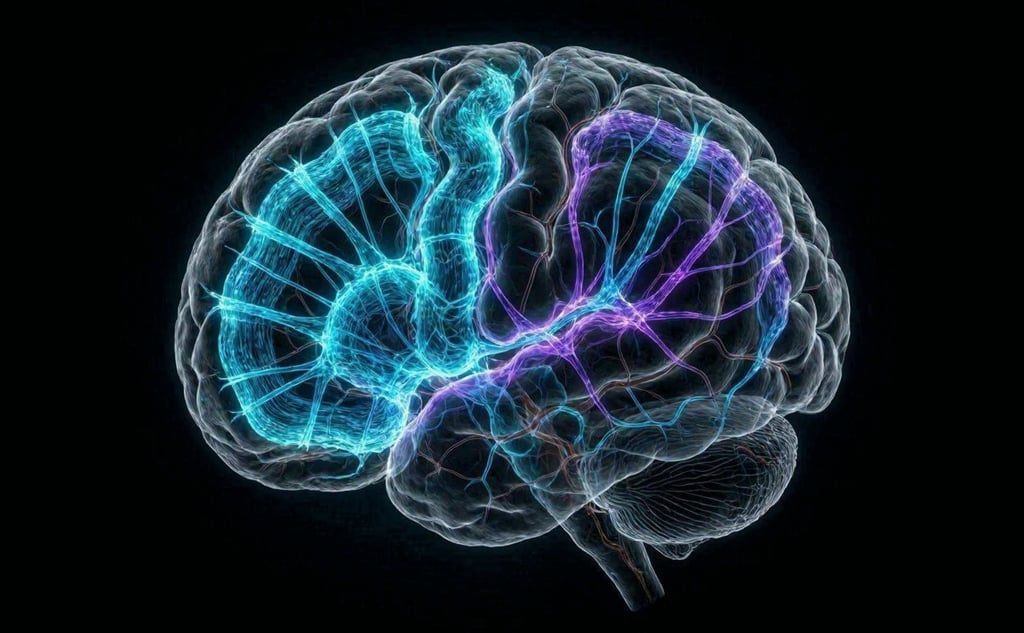
ASMR: Neurological Reality or Pseudoscience? The Verdict
Description: Discover the definitive, scientifically verified guide to ASMR (Autonomous Sensory Meridian Response). Explore the latest fMRI and EEG research, neurological pathways, neurochemistry, and the relationship between ASMR and misophonia. Learn the hard science behind auditory triggers and sensory-emotional gating.
In the early 2010s, a strange sensory phenomenon quietly colonized the internet. Millions of users began seeking out videos of individuals whispering, tapping on everyday objects, brushing microphones, or performing highly personal, simulated tasks like mock medical exams or haircuts. The consumers of this media reported a highly specific, intense physiological sensation: a static-like, pleasant tingling starting at the crown of the scalp, cascading down the neck and upper spine, accompanied by a state of profound, tranquilizing relaxation.
This phenomenon is known as Autonomous Sensory Meridian Response (ASMR).
For years, mainstream science dismissed ASMR as a collective internet delusion, a placebo effect, or a pseudoscientific marketing fad. Because the early communities used highly subjective, non-clinical language to describe their experiences, the scientific establishment largely ignored it. However, over the past decade, advanced functional neuroimaging (fMRI), electroencephalography (EEG), and autonomic physiology studies have cracked open the skull of the ASMR listener. The clinical verdict is now clear: ASMR is not a pseudoscience. It is a genuine, measurable, and highly unusual neurological condition involving atypical sensory-emotional brain wiring.
Fun Fact 1: ASMR shares a profound neurodevelopmental kinship with Synesthesia—the neurological condition where stimulation of one sensory pathway leads to involuntary experiences in a second, unrelated sensory pathway (such as "tasting" words or "seeing" numbers as colors). Quantitative research indicates that individuals who experience ASMR are up to three times more likely to possess traditional synesthesia than the general population, pointing to a common genetic baseline of hyper-connected sensory networks.
The Neurological Reality of the Tingles (fMRI and EEG Diagnostics)
To prove that a subjective sensory experience is a neurological reality, scientists must observe it happening inside the living brain. This requires stripping away subjective self-reports and monitoring the brain's electrical activity and blood-oxygenation levels in real-time.
1. Functional Magnetic Resonance Imaging (fMRI) Discoveries
In breakthrough neuroimaging studies (such as those led by Lochte et al. in 2018 and Smith et al. in 2017), researchers placed ASMR-sensitive individuals inside fMRI scanners and exposed them to common acoustic and visual triggers. The scans revealed distinct, localized patterns of blood-oxygen-level-dependent (BOLD) signal changes that occurred precisely when the subjects reported experiencing the characteristic "tingling" sensation.
The fMRI data highlighted significant hyper-activation in several key structures:
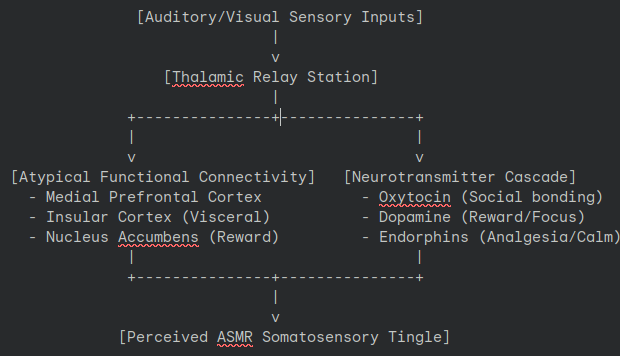
The Medial Prefrontal Cortex (mPFC): This area of the brain is heavily involved in social cognition, self-referential processing, and cooperative social behaviors. The activation of the mPFC during ASMR suggests that the brain processes these highly localized soundscapes (like whispering or personal attention) as genuine, intimate, and safe social interactions. This triggers the biological machinery of social grooming and trust.
The Nucleus Accumbens: As the primary engine of the brain’s mesolimbic reward pathway, this structure regulates pleasure, motivation, and reward. Its activation during ASMR explains why the tingling sensation is perceived as intensely pleasurable and soothing, closely mimicking the neurological response to listening to one's favorite piece of music (a phenomenon known as "musical frisson").
The Insular Cortex (Insula): The insula acts as a bridge between physical sensations and emotional processing. It compiles internal visceral sensations (like heart rate and skin temperature) and translates them into conscious feelings. When the insula lights up during ASMR, it demonstrates a hyper-active link between sensory acoustic inputs and deep, positive emotional responses.
2. Atypical Functional Connectivity: The Default Mode Network (DMN)
Beyond individual brain regions, researchers analyzed the structural wiring of the brain—specifically, how different networks communicate when at rest.
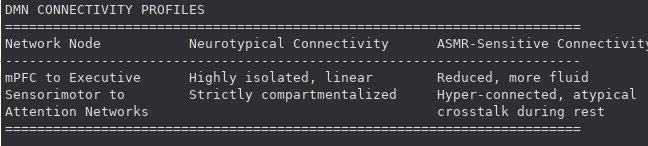
In a landmark study utilizing resting-state fMRI, Smith et al. (2017) demonstrated that individuals who experience ASMR exhibit significantly altered Default Mode Network (DMN) connectivity compared to healthy, non-sensitive control subjects.
In neurotypical brains, the sensory networks (auditory, visual, and somatosensory) remain strictly segregated from executive control and emotional processing networks when the brain is at rest. In ASMR-sensitive brains, however, this segregation is degraded. There is a continuous, highly active crosstalk between the auditory processing areas of the temporal lobe and the somatosensory cortex (which maps touch sensations on the skin). This atypical neural connectivity means that a specific, low-level acoustic trigger (like the light scraping of a cardboard box) is directly translated by the brain into a tactile, physical sensation of tingling on the skin. It is, quite literally, sound touch.
3. Electroencephalography (EEG) and Cortical Entrainment
While fMRI excels at showing where brain activity happens, EEG excels at showing when and how it happens by measuring the millisecond-scale electrical oscillations of the cerebral cortex.
EEG studies of active ASMR states consistently show a dramatic shift in dominant brainwave frequencies:
The Alpha-Theta Transition: During an active ASMR experience, the brain's rapid, analytical Beta waves (12Hz - 30Hz) decrease significantly. In their place, highly synchronized Alpha waves (8Hz - 12Hz) and low-frequency Theta waves (4Hz - 8Hz) take over.
The Flow State Metaphor: This specific electrophysiological signature matches the brainwave profile of experienced practitioners during deep meditation, or athletes in a high-performance "flow state." Theta waves are heavily associated with memory consolidation, highly relaxed focus, and the twilight state immediately preceding deep sleep.
Lack of Sleep Disruptions: Unlike sedative pharmaceuticals, which artificially suppress natural sleep architecture, the acoustic triggers used to stimulate Alpha and Theta waves in ASMR work in harmony with the body's natural sleep-prep mechanisms, gently assisting with sleep onset without destroying normal REM stages.
4. Neurochemical Signaling Pathways
The physical sensation of the tingles is driven by a rapid cascade of neurotransmitters and neuromodulators triggered by atypical brain activation:
Acoustic Trigger -> mPFC activation -> Hypothalamic output -> {oxytocin release; dopamine surge; endorphin satiation}
Oxytocin: Known as the "bonding hormone," oxytocin is released during periods of social trust, physical touch, and physical intimacy. The presence of oxytocin explains the profound feelings of safety, comfort, and maternal/paternal warmth reported by ASMR users during personal attention videos.
Dopamine: The sudden, pleasant onset of the tingling sensation is facilitated by a localized release of dopamine in the mesolimbic pathway, signaling to the brain that the sensory stimulus is highly beneficial and rewarding.
Endorphins (Endogenous Opioids): The immediate reduction in muscle tension and physical pain during ASMR is mediated by endorphins. These natural painkillers bind to opioid receptors in the brain and spinal cord, causing mild, localized analgesia and a tranquilizing somatic sensation.
Fun Fact 2: ASMR has a highly dark, mirror-image counterpart known as Misophonia (literally, the "hatred of sound"). While an ASMR-sensitive person hears whispering, mouth sounds, or chewing and experiences deep relaxation, a misophonic person hearing those exact same sounds experiences a sudden, involuntary surge of intense rage, panic, and physical adrenaline. Neuroscientists now believe that ASMR and misophonia are two sides of the exact same coin—differing only in whether the atypical sensory-emotional gating pathway routes the auditory signal to the brain's reward centers (ASMR) or the raw survival machinery of the amygdala (misophonia).
The Limits of Science: Skepticism, Placebo, and Individual Variation
While the physical and neurological reality of ASMR is firmly established, we must apply rigorous scientific skepticism to the claims made by commercial audio designers, online forums, and wellness influencers. It is vital to separate the true, verifiable neurological mechanism from sensory placebos, exaggerations, and the biological limits of the human population.
Current estimates suggest that only a subset of the global population is capable of experiencing the physiological "tingle" sensation of ASMR. The rest of the population experiences either complete apathy or, as mentioned, mild to severe annoyance (misophonia).
[The Human Population]
|
+-----------------------+-----------------------+
| |
v v
[ASMR-Sensitive] [Non-Sensitive / Apathetic]
- Possesses atypical DMN connectivity. - Segregated sensory/emotional networks.
- Active sensory-emotional crosstalk. - No tactile response to acoustic triggers.
- Releases oxytocin/dopamine. - Can experience boredom or misophonia.
Why does this divide exist? The answer lies in genetics and neural plasticity:
The Oxytocin Receptor Gene (OXTR): Preliminary genetic mapping suggests that individuals who experience ASMR frequently carry specific polymorphisms (variants) in the OXTR gene, which regulates how sensitive their brain is to oxytocin. Those with highly sensitive receptors are far more likely to experience the profound feelings of safety and social bonding triggered by low-intensity vocalizations.
Atypical Pruning in Infancy: During early brain development, the human brain undergoes a massive wave of "synaptic pruning," where unnecessary connections between different sensory regions are systematically dissolved. In ASMR-sensitive individuals, a minor, benign variation in this pruning process likely leaves active, hyper-connected pathways between the auditory and somatosensory cortices intact, creating a lifelong sensory crossover.
2. The Trap of "ASMR Immunity" (Sensory Habituation)
A well-documented phenomenon within the ASMR community is the sudden onset of "ASMR Immunity"—a state where an individual who previously experienced intense, relaxing tingles suddenly ceases to feel anything at all when exposed to the same triggers.
From a clinical perspective, this is not an actual "immunity," but rather Sensory Habituation and receptor down-regulation:
Neural Adaptation: When the brain is repeatedly exposed to the exact same sensory stimulus without any real-world consequence (e.g., listening to the same whispering loop for hours every night), the auditory cortex and thalamus classify the sound as completely irrelevant background noise.
Receptor Down-regulation: The continuous, unnatural flooding of dopamine and oxytocin receptors in the brain’s reward pathways prompts the brain to temporarily scale back the sensitivity of those receptors to maintain homeostatic balance.
The Solution: To reverse this habituation, users must undergo a "sensory fast," abstaining from all ASMR media for several weeks, allowing their neurotransmitter receptors to reset to baseline levels.
3. Distinguishing ASMR from the Autonomous Auditory Placebo
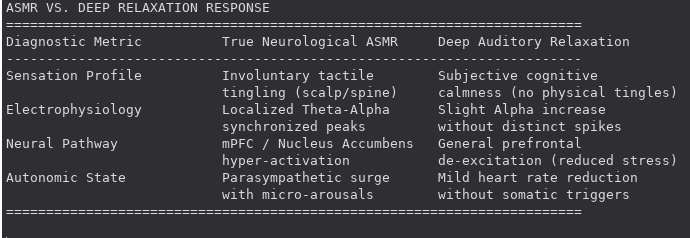
Because ASMR is highly popular, many individuals who do not possess the actual neurological wiring of ASMR still report feeling "relaxed" when listening to quiet, atmospheric audio. This is often confused with true ASMR, but it is actually a standard, healthy autonomic relaxation response—a placebo-adjacent sensory effect.
While both states are highly beneficial for managing acute daily stress and reducing sleep latency, true ASMR is characterized by its involuntary, physical, and tactile nature. It is a distinct, physical reaction to a specific trigger, not just a general, cognitive feeling of peace.
4. Methodological Challenges in Active ASMR Research
To maintain absolute scientific integrity, we must acknowledge the massive methodological hurdles that continue to limit the scope of current ASMR research:
The Scanner Noise Problem: An fMRI scanner is incredibly loud, producing intense mechanical knocking sounds that can easily exceed 100dB. This harsh, industrial environment makes it extraordinarily difficult for highly sensitive subjects to relax enough to experience subtle, low-intensity ASMR triggers.
The Self-Report Bias: Because science cannot yet read a subject's conscious thoughts, researchers must rely on the subject pressing a button to signal when a "tingle" begins and ends. This introducing human error, motor-delay latency, and subjective bias into the timing data of neuroimaging scans.
Lack of Longitudinal Studies: There are currently no long-term studies tracking the neurological effects of daily ASMR consumption over several years. While short-term usage is clearly safe and highly effective for immediate relaxation, the long-term impact on baseline dopamine regulation and sleep architecture remains unmapped.
Fun Fact 3: Recognizing the clinical potential of these highly focused soundscapes, Dreamy Music Paradise operates its internal auditory synthesis setups as an advanced testing ground. By analyzing the physical wave geometry, transient speed, and spectral balances of organic triggers, our team isolates the precise acoustic parameters required to reliably induce the relaxing, non-cognitive physiological states associated with the alpha-theta brainwave transition, completely free from pseudoscientific exaggerations.
The Ultimate Verdict
Autonomous Sensory Meridian Response is no longer a fringe internet curiosity or a pseudoscientific wellness claim. It is a highly real, biologically verifiable neurological condition.
The involuntary, pleasurable tingles of ASMR are the direct, physical output of an elegantly wired brain—a brain that possesses atypical functional connectivity, allowing simple, quiet soundwaves to cascade directly into tactile sensations and deep emotional comfort. While it is not a universal cure-all, and its effects remain bound by genetic and neurological limits, it represents a profound, non-pharmacological pathway to stress reduction, sleep facilitation, and cognitive calm.
By understanding the cold, hard biological laws of sensory-emotional gating, we can look past the hype of the internet and harness the true, restorative power of acoustic design.
Remember: The physical world remains quiet, but for those with the right neural architecture, a single whisper is a key that unlocks a beautifully complex, deeply healing symphony of physical comfort.
Unified Scientific Bibliography
Barratt, E. L., & Davis, N. J. (2015). Autonomous Sensory Meridian Response (ASMR): a flow-like mental state. PeerJ, 3, e851. doi:10.7717/peerj.851. (The first peer-reviewed academic study mapping the demographics, triggers, and subjective physiological profiles of ASMR).
Lochte, T. A., Guillory, S. A., Richard, C. A., & Larson, M. S. (2018). An fMRI investigation of Autonomous Sensory Meridian Response (ASMR). BioImpacts, 8(4), 295-304. doi:10.15171/bi.2018.32. (The definitive neuroimaging study demonstrating active mPFC, insula, and nucleus accumbens blood-oxygenation surges during ASMR experiences).
Smith, S. D., Fredborg, B. K., & Kornelsen, J. (2017). An fMRI investigation of the structural and functional connectivity of Autonomous Sensory Meridian Response (ASMR). Frontiers in Psychology, 8, 247. doi:10.3389/fpsyg.2017.00247. (The landmark scientific paper revealing altered resting-state Default Mode Network)
Poerio, G. L., Blakey, E., Hostler, T. J., & Veltri, T. (2018). More than a feeling: Physiological and affective signatures of Autonomous Sensory Meridian Response (ASMR). PLOS ONE, 13(6), e0196645. doi:10.1371/journal.pone.0196645. (A rigorous clinical study demonstrating that ASMR triggers cause a measurable decrease in heart rate alongside an increase in skin conductance).
Fredborg, B. K., Clark, E. G., & Smith, S. D. (2018). Mindfulness and Autonomous Sensory Meridian Response (ASMR). PeerJ, 6, e5483. doi:10.7717/peerj.5483. (A peer-reviewed psychological study correlating ASMR sensitivity with high baseline scores in mindfulness, sensory sensitivity, and openness to experience).
Dreamy Music Paradise
Acoustic physics for cognitive decompression.