
Psychoacoustics Ultimate Guide
Discover the ultimate guide to psychoacoustics, auditory perception, and sound psychology. Learn how the human brain processes frequency, amplitude, spatial audio, and acoustic illusions. Explore equal-loudness contours, auditory masking, and the science of sound healing for advanced audio engineering and neural entrainment.
Dreamy Music Paradise CopyWriting Team


Psychoacoustics Ultimate Guide: Decoding the Hidden Architecture of Auditory Perception
Description: Discover the ultimate guide to psychoacoustics, auditory perception, and sound psychology. Learn how the human brain processes frequency, amplitude, spatial audio, and acoustic illusions. Explore equal-loudness contours, auditory masking, and the science of acoustic engineering and neural entrainment.
Sound does not exist in the physical world.
This is the first, non-negotiable axiom of acoustic science. Outside of a conscious, perceiving mind, the universe is a silent theater of mechanical kinetics—mere molecules of air colliding, transferring kinetic energy in longitudinal compression waves. What we call "sound"—the devastating resonance of a cello, the piercing clarity of a siren, or the deep, relaxing cradle of ambient music—is a biological construction. It is an intricate, highly sophisticated neurological translation of mechanical pressure into cognitive experience.
The study of this translation is Psychoacoustics. It is the bridge between the mathematical metrics of physics (acoustics) and the subjective territory of human psychology and neurology. To understand psychoacoustics is to gain access to the neural control panel of human emotion, attention, and spatial awareness. It is the science of knowing exactly how the auditory system translates physical air movement into a cognitive, behavioral, and physiological response. For anyone seeking to craft immersive audio, study auditory entrainment, or design effective soundscapes, psychoacoustics is the foundational guide to the craft.
Fun Fact 1: The human ear is so incredibly sensitive to pressure changes that at the absolute threshold of hearing (around 1000Hz), the basilar membrane in your inner ear vibrates by a distance smaller than the diameter of a single hydrogen atom. We are biologically engineered to sense the molecular-scale trembling of our atmosphere.
The Biological Transducer (Anatomy, Physics, and Perceptual Transformations)
To truly understand psychoacoustics, we must first map the biological hardware that makes this perception possible. The human ear is not a linear microphone; it is an active, highly non-linear biological transducer and signal-processing unit.
The Three-Stage Cascade of Auditory Transduction
The physical sound field enters the body through a highly complex, three-stage filter designed to amplify, protect, and digitize raw mechanical vibrations:
The Outer Ear (The Acoustic Filter): The pinna (the external ear flap) is a highly specialized spatial acoustic filter. Its complex folds reflect incoming high-frequency soundwaves, creating tiny, microsecond-scale spectral notches and peaks. These reflections are unique to every individual and form the basis of how our brain determines if a sound is coming from above, below, in front, or behind us. The sound then travels down the external auditory canal, which acts as a natural resonator, boosting frequencies between 2000Hz and 5000Hz—the exact frequency band where human speech intelligibility and high-priority acoustic cues reside.
The Middle Ear (The Impedance Matcher): Sound waves traveling through air (a low-density medium) must be transferred into the fluid of the inner ear (a high-density medium). If air waves hit fluid directly, 99.9\% of the acoustic energy would be reflected away. The middle ear solves this through impedance matching. The tympanic membrane (eardrum) collects vibrations and transfers them to the ossicles—three tiny bones named the malleus (hammer), incus (anvil), and stapes (stirrup). Through a combination of lever-action mechanics and a surface-area ratio reduction (the eardrum is much larger than the oval window of the cochlea), the middle ear amplifies the physical pressure of the sound by approximately 30dB, ensuring the acoustic signal successfully penetrates the inner ear fluid.
The Inner Ear (The Mechanical Spectrum Analyzer): The stapes pumps against the oval window, sending hydraulic waves rolling through the fluid-filled chambers of the snail-shaped cochlea. Inside the cochlea lies the basilar membrane, a structure that acts as a physical Fourier transform. The basilar membrane is highly tonotopic: it is narrow and stiff at the base (highly responsive to high frequencies) and wide and floppy at the apex (responsive to low frequencies). As fluid waves sweep through, the membrane vibrates at specific points corresponding to the incoming frequencies, stimulating the delicate hair cells of the Organ of Corti. These hair cells fire electrical action potentials along the auditory nerve, translating physical motion into the electro-chemical signals of the central nervous system.
The Non-Linearity of Perception: Loudness vs. Amplitude
A common mistake in audio production is treating human hearing as a linear system. In physics, doubling the amplitude of a sound wave represents a predictable, measurable doubling of acoustic pressure. In human psychology, however, loudness is a highly subjective sensation that scales non-linearly.
This phenomenon is mathematically described by Stevens’ Power Law, which governs how subjective sensation scales with physical stimulus intensity:
Ψ(I)=k.Iᵃ
Where:
Ψ(I) is the subjective sensation of loudness.
I is the physical intensity of the stimulus (sound pressure).
k is an experimental scaling constant.
ᵃ is an exponent specific to the sensory modality. For a 1000Hz tone in a free field, ᵃ approx 0.67 (often simplified to 0.6 or 0.33 depending on the specific acoustic environment and measurement paradigms).
This non-linear scaling is further refined by Weber's Law, which dictates that the just noticeable difference JND between two stimuli is proportional to the magnitude of the original stimulus:
△I/I=kW
Where:
△I is the minimum change in physical intensity required for a human to perceive a difference.
I is the starting intensity.
kW is the Weber fraction (a constant).
In practical terms, this means that in a near-silent room, a tiny whisper will sound incredibly loud and distinct. However, in a noisy environment, you need a much larger increase in volume to notice any difference in loudness at all. Our brain dynamically compresses the immense dynamic range of the physical world—spanning over 120dB (a ratio of one to a trillion in physical intensity)—into a manageable, safe perceptual scale.
The Fletcher-Munson Phenomenon (Equal-Loudness Contours)
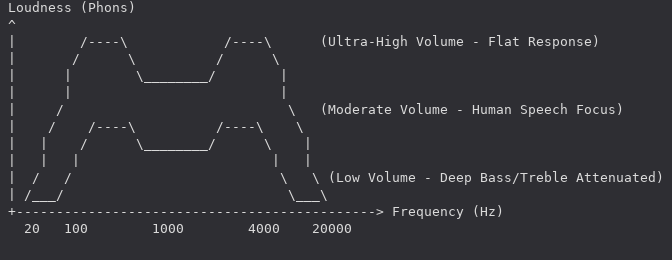
The human auditory system does not have a flat frequency response. We are less sensitive to sub-bass and ultra-high frequencies at low volumes, but our hearing response becomes progressively flatter as the volume increases.
This is mapped on the Equal-Loudness Contours (originally mapped by Fletcher and Munson, and now internationally standardized under ISO 226).
At 20Hz, a sound must be played at nearly 80dB of physical sound pressure level SPL just to reach the absolute threshold of human audibility 0Phons. Meanwhile, at 4000Hz (the resonant frequency band of the ear canal), our threshold of hearing drops below 0dB SPL.
This has massive implications for music production and sound therapy:
The Low-Volume Fallacy: If you mix music or design soundscapes at very low volumes, you will naturally over-boost the bass and treble because your ears cannot hear them well. When played back at a higher volume, your mix will sound muddy, harsh, and bloated.
The High-Volume Trap: Conversely, mixing at excessive volumes flattens your perceived frequency response, making you believe the low-end is perfectly balanced when it actually lacks power at lower playback levels.
The Sweet Spot: The optimal volume for critical listening and sound stage design is between 75dB and 85dB SPL, where our hearing response curve is at its most stable, balanced, and physiologically accurate state.
Fun Fact 2: This non-linear frequency response is why the "Loudness" button exists on older hi-fi stereo receivers. When you play music quietly, turning on "Loudness" boosts the sub-bass and ultra-treble to compensate for the Fletcher-Munson effect at low playback levels, keeping the sound perceived as rich and full.
The Art of Auditory Camouflage (Critical Bands and Masking Thresholds)
One of the most powerful weapons in the psychoacoustic arsenal is Auditory Masking. Masking occurs when the perception of one sound (the target) is completely obscured, altered, or silenced by the presence of another sound (the masker). This is not a physical interference of waves in the air; it is a neurological bandwidth limitation occurring on the basilar membrane and in the brainstem.
The Mechanics of the Critical Band
To understand masking, we must understand the concept of Critical Bands ($\text{CB}$). The basilar membrane behaves like a bank of overlapping bandpass filters. Each segment of the membrane corresponds to a specific critical band—a localized frequency zone where the ear processes incoming spectral energy.
If two frequencies enter the ear and fall within the same critical band, they physically compete for the same sensory hair cells. This leads to two major perceptual outcomes:
Auditory Beating: If the two frequencies are incredibly close (e.g., 440Hz and 442Hz, they stimulate the exact same hair cells in a pulsating pattern, causing the listener to hear a single, modulated pitch that swells in volume at a rate of 2Hz.
Sensory Roughness: If the frequencies are slightly further apart but still within the same critical band (e.g., 440Hz and 470Hz, they cause chaotic, overlapping stimulation of the basilar membrane. The brain cannot separate the two distinct pitches, resulting in a harsh, grating sensation known as acoustic roughness or dissonance.
Resolution: Only when the two frequencies exceed the width of the critical band can the brain resolve them as two separate, clean, and distinct musical tones.
The width of a critical band is roughly constant 100Hz below 500Hz, but increases logarithmically above 500Hz (approaching 15% to 20% of the center frequency).
Spectral (Simultaneous) Masking
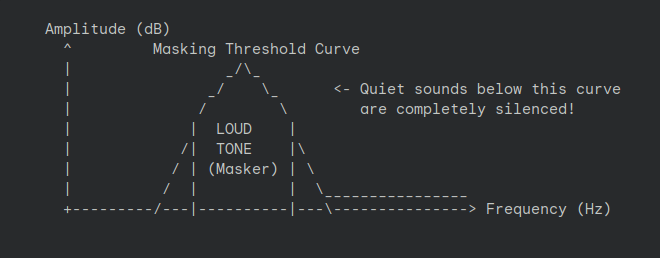
Spectral masking occurs when a loud, dominant sound completely swallows up quieter, adjacent frequencies playing at the exact same time.
The asymmetric shape of the masking curve reveals a vital rule of psychoacoustics: Upward Masking is much stronger than Downward Masking. A low-frequency tone (e.g., a deep bass drone at 100Hz is highly effective at masking higher-frequency tones (e.g., a quiet flute at 800Hz). However, a high-frequency tone is incredibly weak at masking lower-frequency sounds.
Why? Because of the physics of the cochlea. A high-frequency wave peaks near the base of the cochlea and dies out immediately, leaving the rest of the basilar membrane undisturbed. A low-frequency wave, however, must travel through the entire length of the basilar membrane to reach the apex, physically washing over and vibrating the high-frequency detection zones on its way, thereby desensitizing them to quieter, high-frequency inputs.
Temporal (Non-Simultaneous) Masking
Fascinatingly, masking does not only happen when sounds play simultaneously. It can also warp time.
Forward Masking (Post-Masking): After a loud sound suddenly stops, the sensory hair cells and the auditory nerve require a brief period of time (up to 100-200ms) to recover, reset, and return to their baseline chemical state. During this recovery window, a quiet sound played immediately after the loud sound will be completely ignored by the brain.
Backward Masking (Pre-Masking): Even more bizarrely, a quiet, subtle sound can be masked by a loud sound played after it (typically within 10-20ms). This occurs because the neural signal of the loud, high-intensity sound travels faster along the fast-conducting auditory fibers than the weaker neural signal of the quiet sound. The louder sound's signal literally overtakes, collides with, and obliterates the quieter sound's signal in the auditory cortex before the brain has a chance to consciously process it.
Fun Fact 3: Temporal and spectral masking are the secret mathematical pillars behind modern digital audio compression codecs like MP3 and AAC. These algorithms analyze the audio file using a psychoacoustic model, identify every single frequency and sound that is currently masked or silent to the human brain, and permanently delete those gigabytes of data from the file. Your favorite MP3 is practically an acoustic ghost town, but your brain effortlessly fills in the blanks.
The Architecture of Space (3D Auditory Localization and Spatial Psyche)
Human survival has always depended on our ability to localize sound in three-dimensional space with absolute precision. We do not hear space through a simple left/right panning knob; our brain constructs a complex 3D auditory hologram using three primary spatial cues.
1. Interaural Time Differences (ITD)
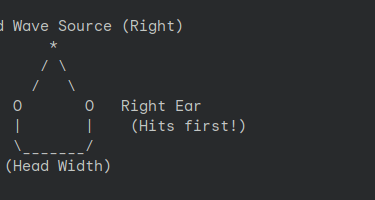
For low frequencies (below 1500Hz, the physical wavelength of the sound is larger than the width of the human head. When a sound is played to your right, the wave easily bends around your skull (diffraction) and hits your right ear slightly before it hits your left ear.
The maximum time delay across a typical human head is approximately 650 microseconds (0.65ms). The brain’s olivary complex processes these micro-delays with astonishing accuracy, allowing us to pinpoint the horizontal angle (azimuth) of low-frequency sound sources with a resolution of just a few degrees.
2. Interaural Level Differences (ILD)
For high frequencies (above 1500Hz), the wavelength of the sound is much smaller than the human head. As a result, the skull acts as a solid physical barrier, casting an "acoustic shadow" over the far ear.
If a 5000Hz sound plays to your right, it hits your right ear at full volume, but is heavily attenuated and muffled by the time it reaches your left ear. The brain calculates this difference in intensity (often up to 20dB at high frequencies) to localize high-frequency sounds on the horizontal plane.
3. Head-Related Transfer Functions (HRTF)
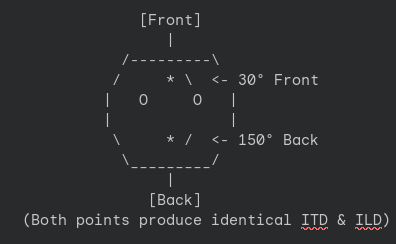
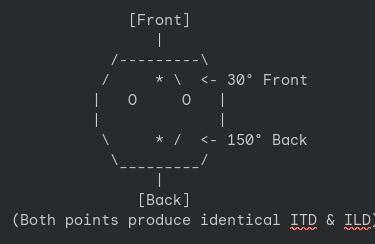
If ITD and ILD were our only cues, we would suffer from a cognitive crisis known as the Cone of Confusion. A sound originating at 30 degrees in front of you creates the exact same time and level differences as a sound originating at 150 degrees behind you.
To break this symmetry, our brain relies on the Head-Related Transfer Function (HRTF). As sound waves strike your unique shoulders, head, and pinna, they bounce off these physical structures. This creates tiny, highly specific frequency notches (attenuated bands) between 5000Hz and 10000Hz.
Because of the physical shape of your pinna folds:
A sound coming from the front will have a specific notch at around 6000Hz.
A sound coming from behind will have its notch shifted to$8500Hz because it had to pass over the back of the ear flap.
Our brainstem is constantly analyzing these spectral signatures, comparing them against an internal, lifelong map of our own anatomy to determine front-to-back elevation and vertical placement in real-time.
The Haas (Precedence) Effect
The Haas Effect (or precedence effect) is a vital psychoacoustic law governing how we perceive sound in reflective indoor environments (like rooms, halls, or cathedrals).
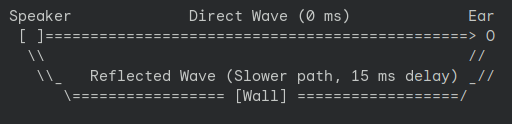
If you are standing in a room and a speaker plays a sound, you hear the direct sound wave first. A few milliseconds later, you hear the early reflections of that sound bouncing off the walls, floor, and ceiling.
The Haas Effect dictates that if the reflections arrive at your ears within 1ms to 35ms of the direct sound, the brain completely fuses them together. You do not hear two separate sounds (an echo); instead, you hear a single, unified sound source, and your brain entirely attributes the spatial location of the sound to the wave that arrived first (the precedence wave). The delayed reflection is ignored for localization, but is subconsciously processed as "spaciousness," adding depth and warmth to the sound. Only when the delay exceeds 50ms does the fusion break down, causing you to perceive two distinct acoustic events (a discrete echo).
Fun Fact 4: This spatial programming is what makes binaural audio and modern spatial ambient music so incredibly powerful. By recording with a dummy head microphone, or by digitally processing raw audio through algorithms that simulate a listener's unique HRTF, ITD, and ILD cues, we can trick the brain into perceiving a highly stable, deeply relaxing 3D sound field out of ordinary, flat stereo headphones.
Auditory Cognitive Processing and Neurological Response
Once we understand how the ear receives, filters, and localizes sound, we can enter the final territory of psychoacoustics: the neurological and autonomic response. How do specific frequency relationships, periodic auditory structures, and rhythms interact with our brainwaves, nervous system, and cognitive states?
The Autonomic Nervous System and Acoustic Structures
Sound does not merely trigger processing in the auditory cortex; it has a direct, measurable influence on the autonomic nervous system. Auditory stimuli are routed from the cochlea through the brainstem to the thalamus, which coordinates sensory routing, and the amygdala, the emotional processing center of the brain.
High-Arousal Stimuli: Unpredictable, transient, or highly dissonant sounds trigger sympathetic nervous system arousal. This "fight-or-flight" state increases heart rate, elevates galvanic skin conductance, and increases cortisol production.
Low-Arousal Stimuli: Predictable, slow-evolving harmonic structures, constant low-frequency drones, and natural soundscapes stimulate the parasympathetic nervous system. This activation decreases heart rate, lowers blood pressure, and decreases systemic stress markers, steering the body toward homeostasis and physiological rest.
The Frequency Following Response (FFR)
The human brain displays electrical oscillations (brainwaves) that reflect its current cognitive and physiological state:
Beta Waves (12Hz - 30Hz}): High alert, active logic, analytical focus, stress.
Alpha Waves (8Hz - 12Hz): Calm, relaxed alertness, creative flow states.
Theta Waves (4Hz - 8Hz): Deep relaxation, meditation, light sleep, memory consolidation.
Delta Waves (0.5Hz - 4Hz): Deep, dreamless, restorative sleep.
The Frequency Following Response (FFR) is a well-documented electrophysiological phenomenon in which brainwaves entrain to match the periodic rhythmic patterns, amplitude modulations, or phase relationships of a continuous external acoustic stimulus.
To utilize this effect, sound designers use two primary acoustic mechanisms:
Binaural Beats (Phase-Based Processing): When a 100Hz tone is played in the left ear and a 106Hz tone is played in the right ear, the waves do not physically mix in the air. Instead, they travel up separate pathways to the superior olivary complex in the brainstem, where spatial hearing is processed. To reconcile this 6Hz phase discrepancy, the brain generates an internal, central nervous system modulation of 6Hz. While binaural beats show mild entrainment effects in EEG studies, the scientific consensus emphasizes that their impact is subjective and heavily dependent on individual attention, context, and baseline states.
Isochronic Tones (Amplitude Modulation): Unlike binaural beats, which are continuous and require headphones, isochronic tones are single tones that are rapidly turned on and off using a specific amplitude envelope (such as a sine or rounded square wave). This periodic pulsing creates a highly distinct rhythmic trigger in the cortical processing centers, facilitating a highly stable and rapid FFR without requiring specialized headphones.
Consonance, Dissonance, and Just Intonation vs. Equal Temperament
The human brain processes musical intervals based on the physics of the harmonic series. When we hear multiple notes played together, we perceive them on a spectrum from consonance (harmonious, pleasant) to dissonance (harsh, tense).
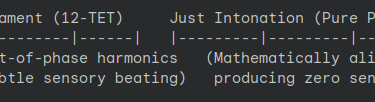
Standard modern Western music is tuned to Twelve-Tone Equal Temperament (12-TET). To make it possible to play in any key without retuning, 12-TET mathematically adjusts the mathematical distance between notes. This results in intervals that are slightly, artificially "imperfect" relative to pure physics.
In contrast, Just Intonation tunes notes based on pure, whole-number mathematical ratios (such as 3:2 for a perfect fifth, or 4:3 for a perfect fourth) derived from the natural harmonic series:
Because the frequencies in Just Intonation align with perfect mathematical symmetry, they produce zero sensory roughness or critical band conflict on the basilar membrane. The auditory cortex does not have to expend cognitive energy resolving micro-beats or harmonic interference, resulting in an immediate perception of acoustic ease, mental clarity, and profound physical relaxation.
Fun Fact 5: The legendary ambient pioneer Brian Eno designed his iconic album "Music for Airports" using slow-evolving tape loops of different lengths that deliberately avoided traditional 12-TET pacing and critical band conflicts. This carefully structured, low-dissonance soundscape was designed to lower the collective autonomic arousal and travel-induced anxiety of busy airport terminals.
The Ultimate Verdict
Psychoacoustics is the definitive proof that we do not experience the physical world directly, but rather through the elegant filter of our biological hardware.
Every sound wave, every silence, and every frequency represents a physical stimulus that alters the chemistry, electricity, and emotional state of the human mind. By mastering the rules of loudness contours, utilizing the science of critical bands and masking, designing soundscapes around the physics of 3D spatial cues, and guiding neurological states through periodic entrainment, we transform from simple noise-makers into precise architects of sensory experience.
The physical universe may be a silent dance of kinetic air molecules, but within the psychoacoustic framework of human consciousness, that silent dance becomes a deeply moving symphony of reality-altering beauty.
Remember: The ear is a biological gatekeeper, but the brain is the ultimate composer. If you understand how the gatekeeper behaves, you can design experiences that speak directly and clearly to the core of human consciousness.
Operational Classification & Boundary Protocol (Non-Medical Statement): The technical research, architectural specifications, and acoustic asset arrays detailed within this monograph are compiled and delivered strictly for independent acoustic validation, industrial workspace environmental calibration, and personal educational research. The synthesis engine functions entirely as an isolated client-side mathematical utility and is fundamentally non-clinical, non-medical, and non-therapeutic. This content does not provide, intend to simulate, or replace professional medical advice, clinical diagnosis, or specialized therapeutic treatment protocols for any physiological, psychological, or neurological conditions, including tinnitus, hyperacusis, ADHD, or autism spectrum sensory processing frameworks. All matrix trajectories are computed locally within the user's isolated local sandbox environment without remote observation, server-side data retention, or the evaluation of personal health criteria.
Unified Scientific Bibliography
Fletcher, H., & Munson, W. A. (1933). Loudness, its definition, measurement and calculation. The Journal of the Acoustical Society of America, 5(2), 82-108. doi:10.1121/1.1915637. (The foundational work establishing equal-loudness contours).
Zwicker, E., & Fastl, H. (2013). Psychoacoustics: Facts and Models (3rd ed., Vol. 22). Berlin: Springer Science & Business Media. ISBN:978-3-540-23159-2. (The definitive, industry-standard reference textbook of psychoacoustic facts).
Moore, B. C. J. (2012). An Introduction to the Psychology of Hearing (6th ed.). Leiden: Brill Academic Publishers. ISBN:978-90-04-25242-4. (A highly acclaimed manual detailing auditory biological mechanics and neural processing pathways).
Haas, H. (1951). Über den Einfluss eines Einfachechos auf die Hörsamkeit von Sprache (On the influence of a single echo on the intelligibility of speech). Acustica, 1(2), 49-58. (The historical landmark paper defining the Precedence Effect).
Oster, G. (1973). Auditory beats in the brain. Scientific American, 229(4), 94-103. doi:10.1038/scientificamerican1073-94. (The benchmark study demonstrating the central brainstem processing of binaural frequency oscillations).



Dreamy Music Paradise
Acoustic physics for cognitive decompression.