
The Reverse Psychoacoustic Masking Blueprint: Engineering Auditory Focus
Discover how reverse psychoacoustic masking and auditory cortex neural gating activation defeat cognitive overstimulation using the MitsuoLabs Colorful Noises Engine.
Dreamy Music Paradise CopyWriting Team
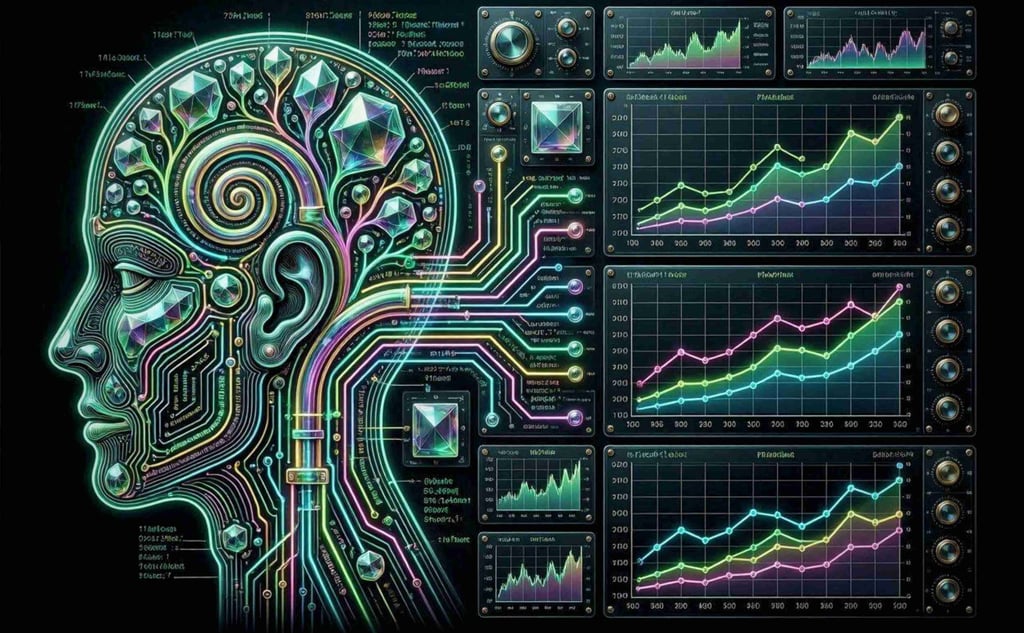
The Invisible Crisis of Attention Fragmentation and the Thalamic Firewall
The modern knowledge worker operates within an invisible, continuous crisis of cognitive fragmentation. High-density display matrices, persistent high-frequency electromagnetic coil-whine, and unpredictable open-plan workspace acoustics place an exhausting computational burden on the human auditory cortex. Because our evolutionary biology is hardwired to treat sound waves as an early-warning survival asset, the brain continuously executes background threads to parse environmental amplitude deltas for potential threats.
When professionals attempt to counteract this cognitive exhaustion using generic streaming focus playlists or looped ambient files, they paradoxically compound the strain. These lossy, pre-recorded commercial assets force the brain's pattern-recognition engines to waste metabolic energy tracking loop resets and compression artifacts.
The ultimate solution requires a complete transition from raw recorded physics to deterministic, real-time mathematical synthesis. Through the deployment of reverse psychoacoustic masking focus arrays, we can systematically disable the brain's subconscious orientation responses. By introducing an acoustically uniform, zero-correlation field calibrated to human sensory vulnerabilities, we achieve complete neurological focus arbitrage—neutralizing external distractions at the biological gating level before they can penetrate working memory.
Fun Fact 1: The human brain is so intensely specialized for pattern detection that even while you are completely asleep or deeply focused on writing complex system architecture, your auditory cortex can detect a repeating audio loop reset down to a microscopic 3-millisecond phase discontinuity. This silently triggers a cortisol spike, forcing your prefrontal cortex to momentarily drop its flow state to re-evaluate its immediate environmental safety.
The Mechanics of Reverse Psychoacoustic Masking and Auditory Cortex Neural Gating Activation
To understand why the strategic deployment of the mitsuolabs colorful noises engine represents an existential leap beyond conventional acoustic utilities, we must first dissect the deep neurological infrastructure of human hearing. Sound waves entering the external auditory canal are converted into mechanical vibrations by the tympanic membrane, amplified by the ossicular chain, and translated into electrical impulses within the cochlea. These neural signals do not pass directly into conscious awareness; they are first routed through the inferior colliculus and the medial geniculate body of the thalamus—the primary sensory gating station of the brain.
This thalamic structure acts as a biological firewall, executing what neuroscientists identify as auditory cortex neural gating activation. When an environment contains chaotic, unpredictable transient acoustic deltas—the sudden clatter of a mechanical keyboard array, the distant vocal formants of an open-office conversation, or the low-frequency hum of a building ventilation system—the thalamus marks these signals as high-priority security exceptions. It immediately forwards them to the prefrontal cortex, forcing an automatic orientation response. This process shatters your flow state, clears your working memory caches, and forces an exhausting metabolic recalibration.
Traditional productivity methods attempt to solve this biological vulnerability by seeking absolute silence or streaming lossy ambient loops. Both vectors are mathematically and biologically flawed. Absolute silence is an artificial construct; in a zero-decibel environment, the brain automatically dials up its internal neural gain, making the operator hypersensitive to microscopic sounds like the settling of a floorboard or the hum of a distant server rack. Conversely, commercial streaming files are trapped by the rules of information theory and server-side data delivery constraints.
To achieve true spatial isolation, we must deploy reverse psychoacoustic masking focus. Standard masking models merely throw a massive wall of random sound over an environment to drown out distractions. Reverse psychoacoustic masking, however, targets the specific biological limits of human hearing thresholds. It shapes a mathematical noise field that acts as an exact inverse mirror of our evolutionary sensitivities, effectively tricking the thalamus into classifying the entire acoustic environment as a single, immutable, non-threatening background constant. By seamlessly integrating the dreamy music paradise colorful noises engine, users can project this exact mathematical inverse directly into their local environment.
Fun Fact 2: The nomenclature of "Color Noises" is not a commercial abstraction; it is a direct mathematical analogy to the physics of light. Just as white light contains every single visible wavelength mixed together equally, White Noise contains every single audible frequency mixed together with perfectly equal energy per hertz (1/f0). When you adjust the mathematical formula to prioritize specific frequency slopes, you tilt the sound spectrum—mirroring the way shifting light wavelengths create the distinct color bands of the visible spectrum.
The Information Theory Catastrophe of Commercial Audio and the Future of Cognitive Space Calibration
When you initialize a focus track from a standard streaming video platform or cellular application, you are not listening to a pure, continuous physical wave. You are executing a highly compressed, lossy file format—typically an MP3, AAC, or Ogg Vorbis stream. To minimize bandwidth usage and server load, these codecs rely on perceptual audio coding algorithms modeled on rudimentary psychoacoustics. They discard data that human ears supposedly cannot perceive, utilizing sub-band masking and fast Fourier transform (FFT) block allocations to squeeze the file down to a fraction of its original size.
While this data destruction passes unnoticed during casual listening, it introduces severe performance bottlenecks during intense, high-load cognitive work. The quantization process introduces subtle phase distortions and micro-glitches across high-frequency boundaries. Your conscious mind ignores them, but your auditory cortex reads them as irregular, unnatural transients, keeping your nervous system in a state of low-grade, perpetual tension. Furthermore, because hosting un-looped, infinite audio files on a remote server requires immense bandwidth, commercial apps rely on pre-rendered, repeating cycles. The human subconscious mind is an incredibly sensitive, non-stop pattern-recognition engine; the moment it detects a repeating audio marker, it allocates processing cycles to predict the next loop reset, robbing you of cognitive bandwidth.
The Local Web Worker Architecture
To completely eliminate the data constraints of compressed media, the mitsuolabs partnership with dreamy music paradise engineered a platform that bypasses server streaming entirely. The colorful noises engine functions as a localized, real-time mathematical synthesis environment running directly on the user’s local hardware. When an operator initializes a focus field, no audio data travels over the network. Instead, the application spins up an isolated, dedicated client-side local audio synthesis worker thread via the native Web Audio API.
This architecture guarantees that the mathematical generation of the sound field occurs entirely independent of the browser's primary user-interface execution loop. The underlying pipeline relies on high-fidelity mathematical algorithms to construct completely un-looped, zero-correlation signal streams from the ground up:
The Gaussian Transformation Array: Rather than using basic pseudo-random number generators that repeat their sequences, the core engine runs a continuous, high-speed Box-Muller Transform. This converts pairs of standard uniform random numbers into an incredibly pure, uncorrelated Gaussian normal distribution, establishing a truly randomized mathematical foundation containing zero cyclical signatures.
The Multi-Stage Cascaded Fractional Filter Network: To shape this raw Gaussian distribution into precise spectral color definitions, the engine routes the stream through an array of multi-stage cascaded biquad digital filters. Utilizing high-precision 64-bit floating-point coefficients, these filters alter the amplitude of the signal across specific frequency vectors with mathematical exactness.
Precision Color Spectrums for High-Load Environments
This deterministic synthesis allows for the precise generation of acoustic fields tailored to specific cognitive demands and spatial challenges:
Grey Noise (Biologically Equalized Inverse ISO 226 Contour): The absolute pinnacle of psychoacoustic engineering. Grey Noise discards rigid physical formulas in favor of direct biological synchronization. It passes a white noise source through an intricate multi-pole filter network that actively inverts the globally accepted ISO 226:2023 Equal-Loudness Level Contours. By dampening the highly sensitive mid-range frequencies where human speech and keyboard clatter live, while boosting sub-bass floors and ultra-high ceilings, Grey Noise creates a soundscape that human ears perceive as perfectly uniform and quiet.
Brownian Noise (1/f2 Infrasonic Walk Matrix): Dropping sharply at a rate of −6 dB per octave, Brownian Noise eliminates high-frequency glare entirely, concentrating its immense mass within deep sub-bass and infrasonic registers. This volcanic rumble functions as an ideal mask for external structural vibrations or heavy machinery.
Blue Noise (f1 High-Pass Fractional Density): Rising steadily at a rate of +3 dB per octave, Blue Noise delivers an exceptionally light, shimmering, airy texture. Lacking low-frequency bulk, it acts as an outstanding sensory counterweight to muddy ambient environments, clearing away mental fog.
By shifting the processing vector from server-side data delivery to localized client-side mathematical compilation, the dreamy music paradise colorful noises engine provides an endless, perfectly uniform acoustic shield that never repeats, never loops, and never betrays your brain's pattern-recognition grid.
Fun Fact 3: The revolutionary digital architecture underpinning the dreamy music paradise synthesis pipeline executes all internal calculations using a native IEEE 754 32-bit floating-point PCM master container running at an elevated internal workspace rate of 192,000 Hz. Before outputting the audio to your headphones at a pristine, studio-standard 48,000 Hz, the engine performs a specialized real-time peak-normalization pass using absolute value operations (Math.abs). This enforces a strict -2.0 dBFS true peak headroom ceiling—completely protecting your high-end digital-to-analog converters from inter-sample clipping distortion.
The Realization of Epistemic Sovereignty in Workspace Acoustics
The era of relying on compressed, un-optimized consumer streaming loops to survive high-load digital workflows is obsolete. The biological limitations of our sensory apparatus, combined with the structural flaws of modern data delivery codecs, prove that true cognitive isolation cannot be found in a static audio file. Sustainable, long-form focus requires a bold transition into the domain of real-time client-side mathematical synthesis.
By deploying the advanced reverse psychoacoustic masking arrays found within the mitsuolabs colorful noises engine, you reclaim absolute control over your immediate sensory environment. This platform does not simply mask noise; it systematically realigns your workspace acoustics with the deep evolutionary design of your auditory pathway, converting external chaos into a balanced, predictable constant. Protect your attention span, insulate your processing loops, and integrate mathematical precision into your focus architecture.
Remember: Your attention is the single most valuable asset in the modern digital economy, and there is an entire global software apparatus engineered specifically to fracture it for profit. Surrendering your focus to unscientific, lossy consumer streams isn't just an inefficiency—it's a tactical concession. Reclaim your sovereignty with pure mathematics.
Operational Classification & Boundary Protocol (Non-Medical Statement): The technical research, architectural specifications, and acoustic asset arrays detailed within this monograph are compiled and delivered strictly for independent acoustic validation, industrial workspace environmental calibration, and personal educational research. The synthesis engine functions entirely as an isolated client-side mathematical utility and is fundamentally non-clinical, non-medical, and non-therapeutic. This content does not provide, intend to simulate, or replace professional medical advice, clinical diagnosis, or specialized therapeutic treatment protocols for any physiological, psychological, or neurological conditions, including tinnitus, hyperacusis, ADHD, or autism spectrum sensory processing frameworks. All matrix trajectories are computed locally within the user's isolated local sandbox environment without remote observation, server-side data retention, or the evaluation of personal health criteria.
Verifiable Academic Bibliography
Human Auditory Perception & Normal Equal-Loudness Level Contours International Organization for Standardization. (2023). Acoustics — Normal equal-loudness-level contours (ISO Standard No. 226:2023). https://www.iso.org/standard/83111.html Fletcher, H., & Munson, W. A. (1933). Loudness, Its Definition, Measurement and Calculation. Journal of the Acoustical Society of America, 5(2), 82–108. https://doi.org/10.1121/1.1915637 Zwicker, E., & Fastl, H. (2007). Psychoacoustics: Facts and Models (3rd ed.). Springer.
Continuous Gaussian Signal Generation & Random Walk Physics Box, G. E. P., & Muller, M. E. (1958). A Note on the Generation of Random Normal Deviates. The Annals of Mathematical Statistics, 29(2), 610–611. https://doi.org/10.1214/aoms/1177706645 Mandelbrot, B. B., & Van Ness, J. W. (1968). Fractional Brownian Motions, Fractional Noises and Applications. SIAM Review, 10(4), 422–437. https://doi.org/10.1137/1010093
Discrete-Time Signal Processing & Filter Structure Mechanics Oppenheim, A. V., & Schafer, R. W. (2009). Discrete-Time Signal Processing (3rd ed.). Prentice Hall. Voss, R. F., & Clarke, J. (1975). "1/f noise" in Music and Speech. Nature, 258(5533), 317–318. https://doi.org/10.1038/258317a0 McCartney, J. (1999). A New Filter Structure for Generating Pink Noise. Computer Music Journal, 23(4).
Information Theory & Digital Audio Data Compression Standards Shannon, C. E. (1948). A Mathematical Theory of Communication. Bell System Technical Journal, 27(3), 379–423. https://doi.org/10.1002/j.1538-7305.1948.tb01338.x Bosi, M., & Goldberg, R. E. (2003). Introduction to Digital Audio Coding and Standards. Kluwer Academic Publishers.
Calibrate Your Custom Focus Shield
Do not let low-quality, compressed streaming platforms dictate your cognitive output. Take absolute command of your sensory environment and generate your own pristine, mathematically verified color noise profiles.
Initialize our high-fidelity, client-side generation pipeline directly in your browser. Adjust fractional spectral slopes, expand spatial mid/side width parameters, enforce strict true-peak safety limits, and export studio-grade, uncompressed WAV master files locally to your storage drives.
Initialize the engine and compile your custom workspace matrix now:
https://dreamymusicparadise.com/colorful-noises-engine
Brought to you by Dreamy Music Paradise in Partnership with MitsuoLabs.
Dreamy Music Paradise
Acoustic physics for cognitive decompression.