
The Science of Binaural Beats: Engineering Deep Focus and Flow
Discover how Dual-Channel Binaural Beats and professional neuro-acoustic engineering can maximize your focus, eliminate distractions, and optimize deep work.
Dreamy Music Paradise CopyWriting Team
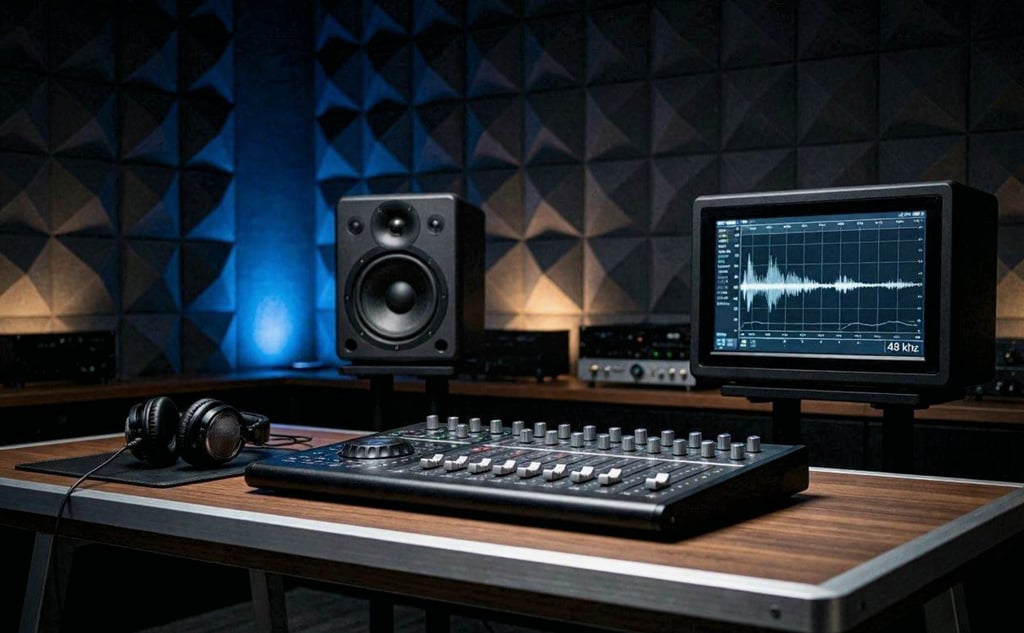
The Science of Auditory Anchoring: How Dual-Channel Binaural Beats Architecture Induces High-Performance Flow States
In an era dominated by hyper-connectivity and cognitive fragmentation, the ability to protect and sustain deep focus is an elite performance metric. While typical ambient soundtracks serve as simple background noise, premium auditory environments leverage advanced acoustic engineering to actively structure cognitive states.
Among these methodologies, Dual-Channel Binaural Beats stand out as a highly verified, non-invasive tool for cognitive optimization and noise masking. By understanding the evolutionary history, technical architecture, and precise neuro-acoustic mechanics of this phenomenon, professionals and creators can systematically access deep work states on demand.
1. What Are Binaural Beats?
A binaural beat is an auditory phenomenon created by the brain when two slightly different frequencies are presented separately to each ear.
Unlike conventional stereo panning—where sound moves across a horizontal plane—a binaural beat is an organic neurological construct. The tone itself does not exist in the physical audio file; it is generated entirely within the listener's central nervous system.
To experience this effect, the use of stereo headphones or precise dual-channel audio systems is structurally mandatory. If the left channel delivers a steady carrier tone of 200Hz and the right channel delivers 240Hz, the physical acoustic waves never mix in the air. Instead, the brain processes the mathematical variance, resulting in an internal perception of a third tone pulsing at exactly 40Hz.
Left Ear: 200 Hz Tone ───────┐
▼
[Brainstem] ──► Perceived Internal Pulse: 40 Hz (The Binaural Beat)
▲
Right Ear: 240 Hz Tone ──────┘
2. The History and Evolution of Neuro-Acoustics
The foundational discovery of the binaural phenomenon dates back to 1839, when Prussian physicist and meteorologist Heinrich Wilhelm Dove observed that presenting differing frequencies to each ear produced a distinct, rhythmic perception of slow beats. At the time, the limitations of mechanical acoustic instrumentation prevented deep investigation into its practical applications.
The true paradigm shift occurred in 1973 with the publication of a landmark study by biophysicist Dr. Gerald Oster in Scientific American. Oster’s research, titled "Auditory Beats in the Brain," isolated the phenomenon from traditional monaural beats (which physically mix in the air).
Oster identified that binaural processing occurs within specific subcortical pathways, demonstrating that the sensory response requires remarkably low acoustic intensity. His work transformed the field from an obscure physics curiosity into a foundational cornerstone of modern acoustic behavioral design, paving the way for high-fidelity digital implementations used today to support focus and environmental tracking.
3. How It Works: The Neurological Mechanism
The generation of a binaural beat relies on the brain's innate hardware for survival and localization. When sound waves hit the human head, they reach each ear at fractions of a millisecond apart, depending on the source's location.
Step 1: Subcortical Processing via the Superior Olivary Complex
When distinct frequencies enter the left and right auditory canals, the electrical signals travel up the auditory nerve to the superior olivary complex (SOC) located in the brainstem. The SOC is the brain's primary site for sound localization and binaural hearing.
Step 2: Phase Alignment and Central Processing
The neurons within the SOC are highly sensitive to interaural phase differences. Because the frequencies in each channel are mismatched, the neural networks attempt to align the overlapping waves. Unable to reconcile the physical phase discrepancy, the brain generates a central, fluid wave configuration that matches the mathematical subtraction of the two input signals:
f beat = | f right - f left |
Step 3: Frequency Following Response (FFR)
Through a biophysical process known as entrainment, neural populations across the cortex tend to align their natural firing rhythms with the frequency of steady, repetitive sensory inputs. When exposed to a persistent 40Hz internal pulse, the brain's global electrical activity naturally mirrors that rhythm, reinforcing specific cognitive parameters associated with that frequency band.
4. Why It Works: The Technical and Engineering Blueprint
To build an auditory environment capable of sustaining long-term concentration without inducing cognitive fatigue, the underlying audio must be engineered to a premium, archival standard. Standard, heavily compressed audio formats often introduce phase distortions that degrade the clarity of the internal beat.
Phase-Aligned 48kHz Offline Rendering
Premium acoustic engineering requires mastering tracks at a native 48kHz sample rate with a 32-bit floating-point audio engine. This prevents digital clipping and ensures that the waveforms sent to each channel maintain perfect phase consistency. If the phase relationship between the left and right carrier frequencies drifts even slightly during export, the internal pulse becomes unstable, disrupting the listener's flow state.
Carrier Frequency Selection and Low-Track Pairing
The choice of the base carrier frequencies heavily influences how comfortably the brain processes the audio field. Lower carrier frequencies (such as a left channel at 90Hz and a right channel at 92Hz to produce a 2Hz Delta wave) leverage deep, non-fatiguing tones that blend cleanly into background soundscapes.
┌────────────────────────────────────────────────────────────────────────┐ ENGINEERING CORNER ├────────────────────────────────────────────────────────────────────────┤
│ Carrier Configuration: Left = 250 Hz | Right = 260 Hz │
│ Resulting Waveform: 10 Hz Alpha Carrier Group │
│ Integration: Voss-McCartney Pink Noise Layering │
│ Purpose: Masks unpredictable environmental noise while maintaining a │
│ highly stable internal auditory anchor for prolonged reading sessions. │ └────────────────────────────────────────────────────────────────┘
5. Applications for Deep Focus and Productivity
By utilizing structured auditory anchors, professionals and creators can choose the ideal acoustic environment to match their specific situational demands:
The Alpha Band 8Hz - 12Hz): Ideal for reading comprehension, light programming, and administrative workflows. The Alpha anchor supports a calm, clear state of mind, helping to mitigate the onset of screen fatigue.
The Gamma Band 30Hz - 40Hz): Geared toward high-intensity cognitive endurance, such as complex engineering, deep writing blocks, or rapid problem-solving. This band acts as a rigorous auditory shield against environmental distractions.
When integrated alongside advanced multi-axis channel routing and organic ambient textures, dual-channel binaural architecture serves as an elegant, non-intrusive tool for reclaiming attention and optimizing performance in demanding workspaces.
Bibliography
Dove, H. W. (1839). Repertorium der Physik. Berlin: Veit & Comp.
Oster, G. (1973). Auditory beats in the brain. Scientific American, 229(4), 94-102.
Galambos, R., Makeig, S., & Talmachoff, P. J. (1981). A 40-Hz auditory potential recorded from the human scalp. Proceedings of the National Academy of Sciences, 78(4), 2643-2647.
Dreamy Music Paradise
Acoustic physics for cognitive decompression.