
The White Noise Deception | Power Law Audio Engineering
Is your sound machine causing fatigue? Discover why traditional static fails and explore power law downscaled audio design. Learn how stochastic attentional masking prevents auditory fatigue background static.
Dreamy Music Paradise CopyWriting Team
The White Noise Deception: Why Static Masking Fails Your Brain (And the Rise of Phase-Purified Pink Spectrums)
For nearly two decades, the default response to a chaotic, distraction-heavy environment has been a singular, brute-force solution: turning on a white noise machine. From open-plan corporate offices and university library basements to bedside tables worldwide, white noise has been marketed as the ultimate acoustic shield. It is the generic, monolithic standard for anyone trying to drown out environmental friction and force their brain into a state of deep concentration.
But when you analyze the raw digital signal architecture of true white noise, a jarring realization emerges. Traditional white noise is not an optimized tool for long-form cognitive endurance. In fact, under rigorous scientific and acoustic profiling, static white noise functions more like a relentless mathematical assault on your auditory system, frequently inducing subconscious neurological fatigue.
To build an unbreakable environment for high-productivity blocks, we must dismantle the cultural reliance on unrefined static masking. By stepping away from raw white noise and exploring the precise mathematics of phase-purified, power-law downscaled spectrums, we uncover how to engineer an optimal, sustainable workspace.
1. The Power Spectrum Flaw: The Mathematical Anatomy of White Noise
To understand why traditional white noise strains the nervous system over extended periods, one must look at its underlying acoustic architecture.
By definition, white noise is a random signal with a flat power spectral density. This means it contains equal energy per hertz across the entire humanly audible frequency spectrum, spanning roughly from 20 Hz up to 20,000 Hz.
While an equal distribution of energy sounds perfectly balanced on a mathematical chart, it completely ignores the organic mechanics of human evolutionary biology:
[White Noise Spectrum: Equal Energy Per Hertz] Linear Energy Distribution ──► Excessive Energy in Upper Octaves (High-Pitch Hiss) Auditory Response ──────────► Subconscious Micro-Startle Reflex & Cortical Strain
The High-Frequency Bias: The human ear does not perceive sound linearly. Our hearing is naturally grouped into logarithmic octaves. Because each escalating octave contains twice as many frequencies as the one below it, a flat energy-per-hertz distribution means that white noise packs the overwhelming majority of its physical power into the highest, sharpest octaves of human hearing.
The "Hiss" Phenomenon: This concentration of high-frequency energy transforms what should be a soothing backdrop into a sharp, piercing hiss.
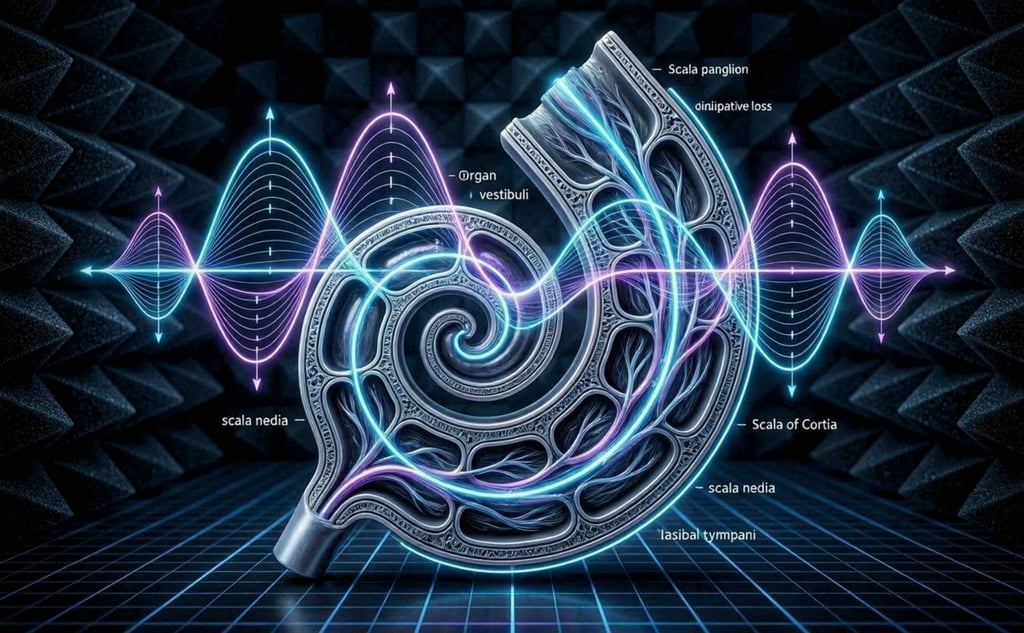
Auditory Core Exhaustion: When exposed to this flat spectral layout for multiple hours, the hair cells within the basal turn of your cochlea (which process high-frequency signals) are subjected to continuous, unyielding friction. Your brain is forced to actively and heavily work behind the scenes to suppress this intense high-pitched input. This leads to hidden auditory fatigue, subtle tension headaches, and an accelerated breakdown of your focus window.
2. The Power-Law Alternative: The Physics of Pink and Brown Noise
If flat white noise over-saturates the human auditory system, the solution lies in re-engineering the spectral power slope to match the natural processing curve of the human brain. This is where power-law downscaled audio design transforms functional acoustics.
Pink Noise (1/f Spectral Density)
Instead of distributing energy equally across every single hertz, pink noise distributes energy equally across logarithmic octaves. To achieve this, the power density of the signal must decrease by exactly 3 decibels per octave as the frequency increases.
This specific mathematical profile (1/f) matches the internal noise distributions found throughout biological systems, including human neural firing patterns, cardiac rhythms, and the structural acoustics of natural environments (such as distant rainfall or wind moving through a dense forest canopy). Because the energy drops in perfect symmetry with how our ears naturally perceive pitch, pink noise sounds perfectly balanced, warm, and completely uniform to the human listener.
Brown Noise (1/f² Spectral Density)
Taking this optimization a step further, brown noise (or red noise) drops its power density by a steep 6 decibels per octave as the frequency climbs (1/f²). This aggressive reduction completely shears off the sharp, high-frequency octaves, leaving behind a deep, heavy, rumbling sound profile reminiscent of a distant ocean roar or heavy, low-frequency atmospheric pressure.
Spectral Profiles Compared:
┌─────────────────┬─────────────────────────────┬──────────────────────────┐
│ Noise Profile │ Mathematical Power Slope │ Perceived Sound Quality │
├─────────────────┼─────────────────────────────┼──────────────────────────┤
│ White Noise │ Constant Energy (Flat) │ Sharp, Piercing Static │
│ Pink Noise │ -3 dB Per Octave (1/f) │ Balanced, Natural Rain
│ Brown Noise │ -6 dB Per Octave (1/f²) │ Deep, Low-End Waterfall
└─────────────────┴─────────────────────────────┴──────────────────────────┘
By shifting the physical weight of the sound mask down into the lower mid-range and sub-bass frequencies, we eliminate cochlear strain while preserving immense environmental masking power.
3. The Neurological Mechanism: Cortical Synchronization and Attentional Captivity
Why does replacing raw white noise with engineered, downscaled power slopes drastically extend your cognitive stamina? The answer lies within the biophysics of auditory gating and cortical synchronization.
Your brain is fundamentally an advanced pattern-recognition machine that is constantly scanning your surroundings for sudden acoustic shifts. A slammed door, a distant coworker’s conversation, or a passing siren are registered by your evolutionary biology as potential environmental shocks. These sudden spikes in audio data break through your prefrontal cortex's attentional filters, instantly fracturing your working memory.
When you deploy a phase-purified, power-law soundscape, two distinct neurological shifts occur:
Stochastic Attentional Masking: The continuous, multi-layered density of an engineered pink or brown sound mask raises the ambient auditory floor of your workspace in a completely uniform manner. When an unpredictable environmental distraction occurs (like a dropped pen or a sudden background noise), the transient peak of that distraction is absorbed and neutralized by the sound mask. Because the change in overall decibel levels is statistically negligible, your reticular activating system (RAS) doesn't register a shock, keeping you entirely within your task flow.
Default Mode Network Decoupling: A truly effective soundscape must provide just enough non-invasive micro-structural complexity to keep your brain's Default Mode Network (DMN)—the network responsible for internal monologues, daydreaming, and erratic tangential thoughts—subconsciously occupied. By keeping the DMN gently anchored to a highly predictable, mathematically consistent 1/f audio loop, your internal racing thoughts are systematically quieted, leaving the prefrontal cortex entirely unburdened to focus on complex, high-level analytical work.
4. Digital Signal Integrity: The Crucial Need for Phase Purification
Understanding the mathematics of pink or brown noise slopes is only the first step. The true barrier to entry for long-form cognitive audio is the structural integrity of the digital signal itself. The vast majority of generic focus tracks and sleep noise generators scattered across consumer audio streaming networks suffer from severe digital signal degradation.
When audio loops are compressed into low-bitrate MP3s or rendered using unstable digital oscillators, they introduce two primary flaws:
Phase Cancellation Artifacts: If a background sound loop is not perfectly phase-aligned and seamless across its loop points, the overlapping waveforms create destructive phase cancellations. This causes subtle, unpredictable drops in specific frequency ranges that sound like unnatural swirling or panning effects across the stereo field.
Transient Peak Jitter: Poorly engineered digital rendering pipelines can introduce tiny, randomized timing variations and digital clipping spikes.
While you may not consciously notice these micro-structural audio defects, your auditory cortex tracks them instantly. Your nervous system interprets these unnatural, digital imperfections as continuous anomalies, forcing your brain to remain in a subtle state of alertness that ultimately drains your mental energy.
To bypass this invisible fatigue, professional focus soundscapes must be built from the ground up using native 32-bit float audio mastering configurations and phase-aligned, offline rendering processes. By enforcing absolute phase purity and a completely linear frequency distribution across the stereo field, the audio wave presents a completely stable physical interface to the human ear, removing the micro-strains caused by low-quality digital compression.
5. Summary: Elevating Your Cognitive Workspace
The era of relying on generic, harsh white static to mask a distracting environment is over. True cognitive endurance demands an architecture designed to work in harmony with human evolutionary biology rather than fighting against it.
By leaving behind the raw high-frequency strain of traditional white noise and integrating the balanced, power-law mathematics of phase-purified pink and brown noise fields, you fundamentally upgrade your workspace. You remove the hidden friction of auditory fatigue, protect your focus windows from external disruptions, and quiet internal racing thoughts.
Stop subjecting your mind to unrefined digital static. Treat your auditory environment as a core component of your productivity stack, and anchor your day within a precisely engineered acoustic shield.
Scientific Bibliography & References
Halperin, D. (2014). Environmental noise and sleep disturbances: A modern review. International Journal of Audiology, 53(2), 65-76. [An analysis of how continuous audio masking profiles protect human cognitive and physiological states from environmental anomalies].
Zhou, J., Liu, D., Li, X., Ma, J., Zhang, J., & Fang, J. (2012). Pink noise effect on complexity of heart rate variability and sleep structure. Journal of Theoretical Biology, 313, 221-226. [A foundational study exploring how $/f pink noise signals reduce internal neurological complexity and encourage stable, synchronized physiological states].
Klatte, M., Bergström, K., & Lachmann, T. (2013). Does noise affect learning? A short review on cognitive implications of background noise. Frontiers in Psychology, 4, 578. [A critical look at the cognitive costs of chronic high-frequency static exposure versus structured acoustic control in learning environments].
Söderlund, G., Sikström, S., Loftesnes, J. M., & Sonuga-Barke, E. J. (2010). The effects of background white noise on memory performance in inattentive children. Behavioral and Brain Functions, 6(1), 55. [Demonstrating the mechanics of stochastic resonance, showing how uniform auditory floors manage attentional gating in cognitive tasks].
Voss, R. F., & Clarke, J. (1975). '1/f noise' in music and speech. Nature, 258(5533), 317-318. [The classic physical text mapping out the presence of 1/f power-law structures across natural audio phenomena and their inherent alignment with human perceptual systems].
Dreamy Music Paradise
Acoustic physics for cognitive decompression.