
Why Gaming Music Doesn't Feel the Same: From 8-Bit Constraint Mastery to Algorithmic Horizons
Complete historical and psychoacoustic analysis of video game music evolution, detailing the shift from hardware-bounded 8-bit programmable sound generators (PSG) to modern cinematic orchestration and the future of interactive real-time generative audio upscaling.
Dreamy Music Paradise CopyWriting Team
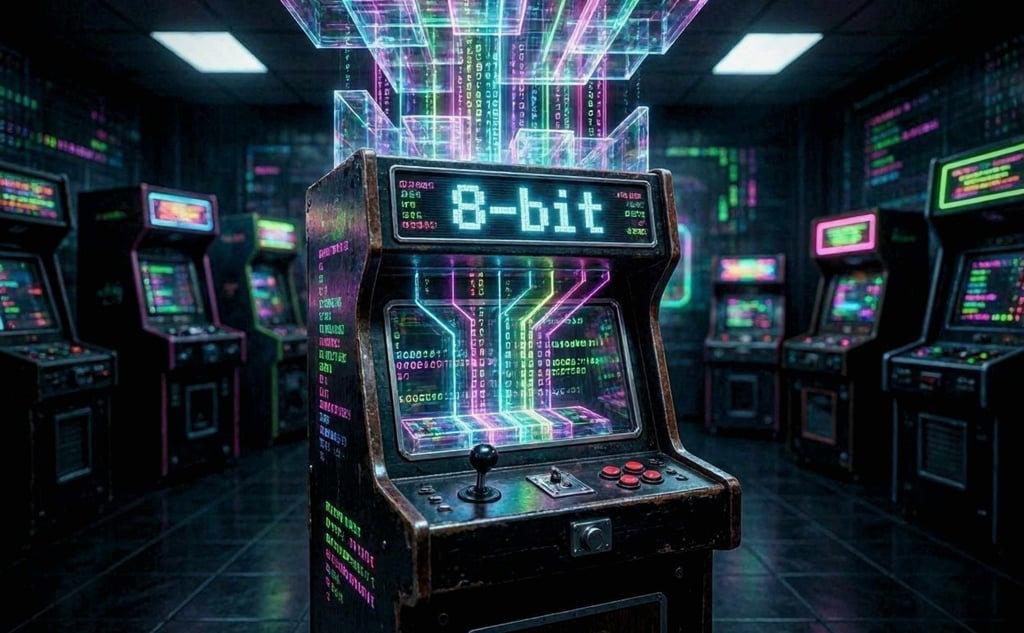

Why Gaming Music Doesn't Feel the Same?
Every developer, programmer, and digital native has experienced the phenomenon: the baseline of a three-decade-old platformer remains instantly recognizable, yet the orchestral theme of a modern cinematic blockbuster fades from memory the moment the console powers down. This is not a trick of selective memory or personal nostalgia. The shift in how game music feels is the direct result of a fundamental evolution in computer engineering, mathematical information theory, and human psychoacoustics.
As early console hardware forced composers to work within tightly restricted channels, they were driven to maximize melodic entropy. Today's boundless digital audio pipelines, by contrast, prioritize cinematic immersion over distinct melodic identity. Understanding this transformation requires analyzing the technical mechanics of early sound chips and looking ahead to the future of generative, algorithmic audio.
Fun Fact 1: Early programmable sound generators did not playback recorded audio waveforms; they functioned as real-time hardware synthesizers, executing automated code instructions with every single CPU cycle to manipulate raw electricity into precise geometric sound waves.
To understand why early game soundtracks feel structurally distinct, one must analyze the stark physical limitations of early audio hardware. The Ricoh RP2A03 microchip powering the 8-bit Nintendo Entertainment System (NES) did not have the storage space, RAM, or processing cycles to stream pre-recorded audio files. Instead, it was an integrated Programmable Sound Generator (PSG) that offered exactly five sound channels. Each channel possessed a rigid geometric identity and clear functional boundaries.
┌─────────────────────────────────────────────────────────────────┐
│ The 8-Bit Ricoh RP2A03 Pulse Wave Duty Cycles │ ├───────────────────┬─────────────────────────────────────────────┤
│ 12.5% Duty Cycle │ Produces a sharp, reedy, piercing timbral │
│ │ profile optimized for lead woodwind emulation│ ├───────────────────┼─────────────────────────────────────────────┤
│ 25.0% Duty Cycle │ Yields a bright, balanced, classic chiptune │
│ │ presence for primary melodic signatures │ ├───────────────────┼─────────────────────────────────────────────┤
│ 50.0% Duty Cycle │ Generates a hollow, warm, rounded square │
│ │ wave mimicking clarinets or hollow synths │ └───────────────────┴─────────────────────────────────────────────┘
The first two channels were dedicated entirely to pulse (square) waves, equipped with variable duty cycle selectors (12.5%, 25%, and 50%) that altered the harmonic spectrum to define lead melodies and harmonic counterpoints. The third channel generated a fixed-volume triangle wave, which composers assigned to drive the bassline or simulate lower woodwinds.
The fourth channel produced pseudo-random white noise used exclusively for percussive hits, explosions, and snare simulations. The fifth channel, a rudimentary Delta Pulse Code Modulation (DPCM) channel, could play back heavily compressed, low-sample-rate audio clips at the cost of valuable system memory.
Because composers like Koji Kondo (Super Mario Bros.) and Hirokazu Tanaka (Metroid) were limited to this sparse environment, they could not rely on sweeping orchestral textures or complex atmospheric pads to mask a weak composition. Information theory dictates that when a transmission channel is heavily restricted, the data sent through it must carry high structural density to be effective.
Composers were forced to write unforgettable melodic hooks, arpeggiated chords, and syncopated rhythms that clearly cut through the sonic landscape. Every note had to justify its drain on the hardware, resulting in highly memorable themes designed to keep players focused and engaged through repetitive gameplay loops.
┌─────────────────────────────────────────────────────────────────┐
│ Structural Comparison of Video Game Audio Eras │ ├─────────────────────┬───────────────────┬───────────────────────┤ │
Technical Attribute │ 8-Bit/16-Bit Era │ Modern AAA Gaming │ ├─────────────────────┼───────────────────┼───────────────────────┤
│ Audio Delivery │ Real-time code │ Pre-rendered linear │
│ │ PSG synthesis │ PCM streams & streams │ ├─────────────────────┼───────────────────┼───────────────────────┤
│ Structural Density │ High melodic focus│ High atmospheric and │
│ │ and clear hooks │ textural composition │ ├─────────────────────┼───────────────────┼───────────────────────┤
│ Integration Model │ Hard-coded into │ Dynamic middleware │
│ │ the game engine │ engines (FMOD/Wwise) │ └─────────────────────┴───────────────────┴───────────────────────┘
When the industry advanced to the 16-bit generation, chips like the Super Nintendo's Sony SPC700 introduced 8-channel ADPCM sample playback. This allowed composers to utilize digitized instruments, but the total audio RAM remained capped at a strict 64KB. This constraint meant instrument samples had to be microscopic, forcing musicians to rely on clever looping techniques and pristine voice leading to sustain harmony.
Soundtracks like Yuzo Koshiro's Streets of Rage or Yoko Shimomura's Street Fighter II became legendary because they operated at the absolute threshold of what the silicon could support, turning engineering limitations into raw, high-impact musical art.
Fun Fact 2: The iconic basslines of early video games were assigned to a dedicated triangle wave channel that lacked independent volume control, forcing composers to create emphasis entirely through rhythmic spacing and melodic contouring.
The Modern Era: The Cinematic Shift to Sonic Wallpaper
The transition to optical media and modern storage architectures completely eliminated hardware-enforced audio constraints. Contemporary game platforms stream uncompressed, multi-channel Linear PCM audio directly from storage arrays, utilizing modern audio middleware engines like Wwise and FMOD to manage complex dynamic mixing pipelines.
While this technological leap has granted composers the ability to record live symphony orchestras and layer intricate electronic textures, it has fundamentally transformed the role of music within interactive media.
Modern game audio design typically models itself after contemporary Hollywood film scoring. Rather than standing out as a distinct, whistleable hook, the soundtrack is carefully engineered to serve as a supportive acoustic backdrop. Its primary purpose is to blend seamlessly into the environment, dynamically heightening tension, fear, or wonder without distracting the player from complex voice acting, spatialized footsteps, and hyper-detailed environmental sound effects.
[Traditional Linear Loop] ──► Fixed Repetition ──► High Melodic Salience
[Modern Adaptive Matrix] ──► Real-Time FMOD ──► High Atmospheric Integration
Furthermore, modern scores are highly adaptive and structurally fluid. Instead of playing a single static track on a loop, modern audio engines divide compositions into multi-layered matrices that shift in real time based on player behavior. When a player transitions from open exploration to active combat, the middleware smoothly dials in high-frequency percussion layers, shifts the harmonic mode, or adjusts the filter cutoff frequencies.
To prevent this fluid system from jarring the listener or breaking immersion, the underlying music must remain atmospheric and open. Strong, distinct melodies are intentionally avoided, as a looping melodic hook would quickly become repetitive and irritating during an extended exploration sequence. As a result, music has largely shifted from a primary structural narrative force into a highly polished form of sonic wallpaper.
The Architecture of Psychoacoustic Acoustic Fatigue
The Loudness War Trend: Modern mastering techniques often rely on aggressive brickwall limiting to maximize average loudness, which can strip away dynamic range and accelerate listening fatigue during long sessions.
Complex Auditory Masking: When a game engine mixes dense orchestral brass, roaring explosions, and constant spatialized chatter simultaneously, it creates significant acoustic competition, causing the brain to work harder to parse individual sounds.
Predictable Cadence Loss: By removing the steady, clock-synced rhythm of early hardware tracks, modern adaptive scores lose the clear temporal framework that helped anchor a programmer's or player's focus.
Fun Fact 3: To ensure complete acoustic clarity on Dreamy Music Paradise, every single focus arrangement is produced and mastered using an uncompromised, native 32-bit floating-point architecture, preventing the accumulation of digital rounding errors and protecting the listener's long-term attention span.
The Future Horizon: Infinite Upscaling and the Perceptual Ceiling
As we look toward the future of interactive audio engineering, we are rapidly approaching a fascinating technical intersection. Current high-resolution game audio is mastered at standard digital boundaries—typically 24-bit depth at 48kHz or 96kHz sampling rates.
With the emergence of local edge-computing AI accelerators, real-time procedural audio synthesis, and neural audio upscaling networks, game engines will soon be capable of generating sound fields with infinite digital resolution.
However, this trajectory will eventually collide with the Human Perceptual Ceiling. The human auditory system is governed by absolute biological limitations. The human ear can only perceive frequencies up to roughly 20kHz, and our cognitive architecture cannot distinguish subtle differences in acoustic waveforms past a certain resolution threshold. To a human listener, a real-time, AI-upscaled 32-bit/384kHz digital audio stream will sound virtually identical to a clean, well-mastered standard file.
[Low-Resolution PSG] ──► [Linear PCM Stream] ──► [Hyper-Res Algorithmic Engine] │
(Perceptual Ceiling: Human Limit Reached) │
└──► [Continuous Machine Learning Tracking]
The New Listeners: Algorithmic Systems and Learning Models
While human ears will inevitably plateau, the advanced systems driving future virtual worlds will not. Future game engines will generate and process hyper-resolution audio metadata not merely for human ears, but for the internal algorithmic models governing the game environment itself.
Algorithmic Audio Interaction: Future game engines will use hyper-resolution audio data to calculate the exact acoustic physics of a virtual space. Non-player characters (NPCs) will utilize real-time phase alignment and microscopic wave reflections to calculate a player's precise location, speed, and weight based on their footsteps.
Generative Real-Time Remixing: Advanced AI audio systems running locally on hardware will continuously monitor player input, style, and biometric metrics. The system will subtly modulate the micro-frequencies, harmonic balance, and tempo of the background audio to maintain optimal immersion or minimize cognitive strain.
Deep Code Synthesis: Future procedural sound engines will translate hardware processing loads and system execution states into subtle, microscopic acoustic textures. While these textures may only be processed subconsciously by the human user, they will provide artificial perception networks with real-time tracking data for total system synchronization.
Conclusion: The Asymptotic Evolution of Sound
Gaming music feels different because its fundamental purpose has changed. It evolved from a prominent, melodic guide navigating you through a primitive digital world into an intricate, immersive environment designed to envelop your senses.
While the future points toward an era of limitless, hyper-optimized audio upscaling, the classic soundtracks of the 8-bit and 16-bit eras remain an enduring testament to what can be achieved when creativity is focused through the lens of strict hardware limitations.
Remember: True artistic resonance is not achieved by the infinite expansion of digital resources, but by the precise, intentional mastery of the constraints you are given.
References & Technical Frameworks
Historical Game Hardware Constraints: Collins, K. (2008). Game Sound: An Introduction to the History, Technical Performance, and Strategy of Video Game Audio. MIT Press.
Mathematical Information Theory: Shannon, C. E. (1948). A mathematical theory of communication. Bell System Technical Journal, 27(3), 379–423.
Psychoacoustic Hearing Contours: Fletcher, H., & Munson, W. A. (1933). Loudness, its definition, measurement and calculation. Journal of the Acoustical Society of America, 5(2), 82–108.
The Physics of 1/f Power-Law Structures: Voss, R. F., & Clarke, J. (1975). '1/f noise' in music and speech. Nature, 258(5533), 317–318.
Stochastic Resonance and Cognitive Gating: Söderlund, G., Sikström, S., & Smart, A. (2007). Listen to the noise: noise is beneficial for cognitive performance in ADHD. Behavioral and Brain Functions, 3(1), 17.
Mathematical Transforms for Gaussian Noise Fields: Box, G. E. P., & Muller, M. E. (1958). A Note on the Generation of Random Normal Deviates. The Annals of Mathematical Statistics, 29(2), 610–611.
Spatial Audio Imagery and Cross-Correlation: Kendall, G. S. (1995). The Decorrelation of Audio Signals and Its Application to Spatial Imagery. Computer Music Journal, 19(4), 71–87.
Dreamy Music Paradise
Acoustic physics for cognitive decompression.